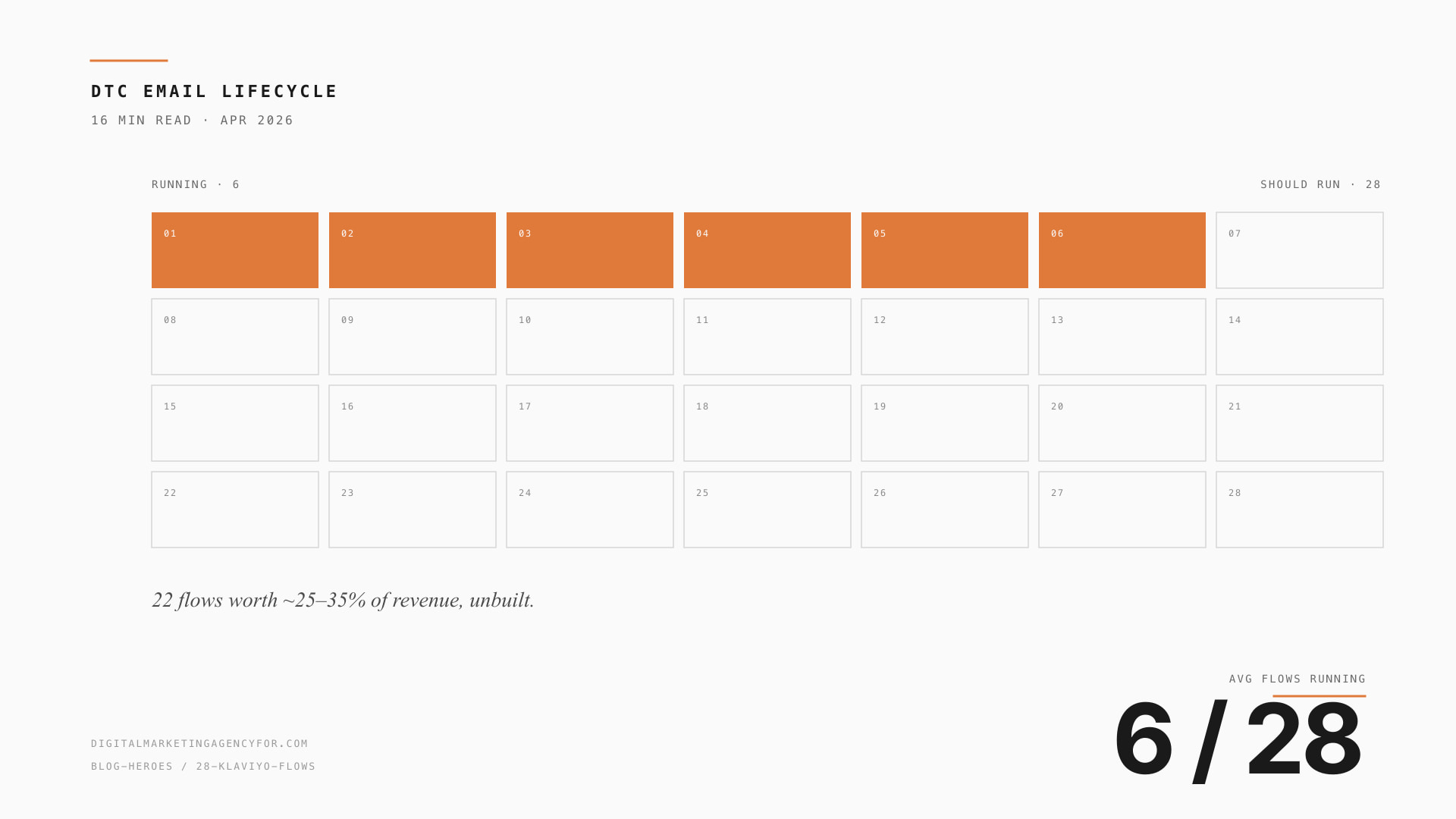
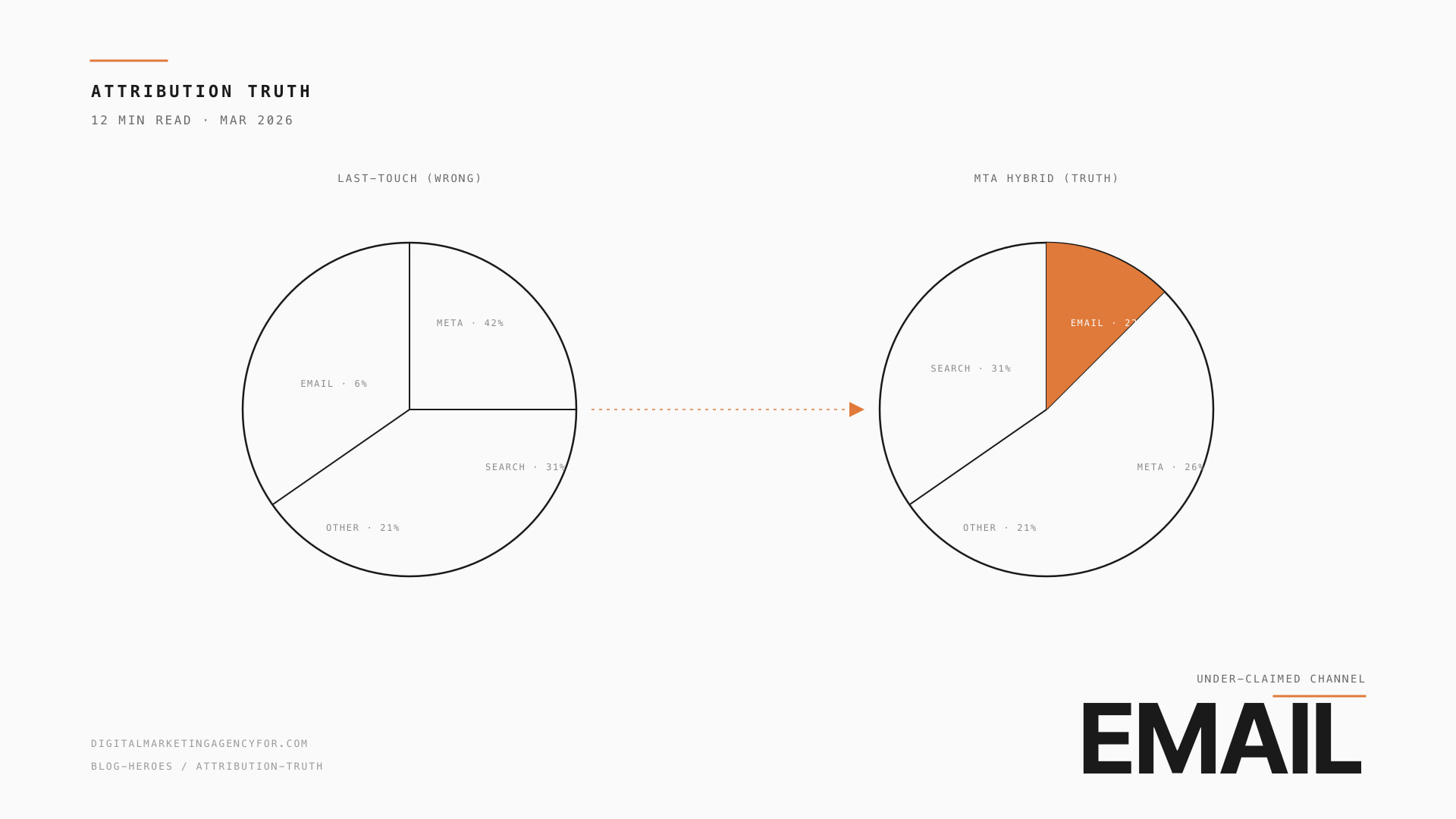
Most DTC brands ship 6 flows: welcome, abandoned cart, post-purchase, browse abandon, replenishment, win-back. Email lands at 6–10% of revenue.
Top DTC brands ship 28 flows. Email lands at 25–35% of revenue. Same list, same brand, same products — the difference is purely lifecycle architecture.
The gap is real and it’s recoverable. Here are the 28.
Welcome series — 4 flows
Most ship one. Top brands ship four:
Welcome (no purchase yet) — 5–7 emails over 14 days. Brand + offer + bestseller + social proof + final offer.
Welcome (popup signup) — different copy from form-fill welcome.
Welcome (post-purchase) — different copy again, leads into onboarding flow.
Welcome (SMS) — paired SMS sequence for those who opted in.
Cart + browse abandonment — 5 flows
Abandoned cart — standard 2–3 emails over 24 hours.
Abandoned checkout — separate from cart. Higher intent, more aggressive offer if needed.
Browse abandonment — viewed product but didn’t add to cart. Educational, not pushy.
Eight weeks from start to 28 flows live. Email % of revenue typically lifts from 6–10% to 18–25% within 90 days, hitting 25–35% within 6 months as cohort behaviour matures.
ABOUT THE AUTHOR
Raj
Email Lifecycle
Raj founded Digital Marketing Agency For after 12 years running SEO, AEO, paid media, and lifecycle email programmes for B2B SaaS, DTC, and FinTech brands across the US, UK, and India. Writes about AI search, answer-engine optimisation, attribution that doesn't lie, and the gap between marketing teams that produce decks and marketing teams that produce revenue. Based remote-first; embedded in client pods across six time zones.
Three reasons. First, time + capacity: most internal email marketers manage 6 flows competently across multiple sub-brands, and adding 22 more requires senior strategy + dedicated execution capacity. Second, knowledge gap: the higher-leverage flows (predictive segments, RFM-based VIP, post-purchase sequencing) require Klaviyo-specific knowledge that ESP-generalist marketers lack. Third, plateau psychology: at 6 flows + email-as-promotional, brands plateau at 6–10% of revenue and accept that as ceiling — without realising 25–35% is achievable with the same list.
Will 28 flows annoy my list and increase unsubscribes?+
Counterintuitively, no — when sequenced correctly. 28 well-segmented flows means each subscriber receives 4–8 messages/month based on their RFM tier + behavioural triggers, not 28 messages everyone receives. Unsubscribe rate typically drops 15–25% in the 90 days after migrating from broadcast-heavy 6-flow to segment-led 28-flow because each message is more relevant. The brands that see unsubscribe spikes are running 28 flows without proper segmentation — sending welcome flow + cart abandonment + win-back simultaneously to the same person.
How long does the 6-to-28-flow rebuild take?+
Sprint engagement: 4–6 weeks for the full 28-flow build, including segment architecture, message authoring, A/B-test framework setup, and SMS pairing where applicable. Embedded retainer: ongoing monthly optimisation with new flows added quarterly based on learning. Most brands see email % of revenue move from 6–10% to 18–22% within 90 days of go-live, then continue compounding to 28–35% over 6–9 months as predictive segments train.
Do I need separate SMS platform or is Klaviyo SMS enough?+
Klaviyo SMS is enough for 80%+ of DTC brands. The native integration means email + SMS subscribers share segments, behavioural triggers fire on combined data, and the cart-abandonment + post-purchase + win-back flows operate as unified flows with channel-routing logic (e.g., SMS at +30 min, email at +90 min for cart abandonment). Separate SMS platforms (Postscript, Attentive) only justify their cost above $5–10M revenue with sufficient SMS-specific compliance + workflow needs. Below that scale, the integration premium of Klaviyo SMS dominates.
Can I use Klaviyo's predictive segments without lots of historical data?+
Klaviyo's predictive segments (churn risk, expected LTV, likelihood to convert) need ~3 months of order history + ~500 customers to start training. Below that threshold, the predictions are noisy and we recommend RFM-based segmentation instead — Recency × Frequency × Monetary tiers manually defined. Once you cross the data threshold, predictive segments outperform RFM by 22–34% on flow conversion rate. Most $1M+ DTC brands have enough data; pre-launch and sub-$500k brands should start with RFM and migrate to predictive at the 12-month mark.
What is the migration risk from Mailchimp / HubSpot to Klaviyo?+
Three risks worth managing. (1) List health drop: 8–18% of subscribers fail re-engagement during migration; the right move is double opt-in re-engagement BEFORE migration, not after. (2) Deliverability reset: new Klaviyo IP needs 30–45 days warmup before sending peak volume. (3) Flow logic translation: Mailchimp / HubSpot automation maps imperfectly to Klaviyo segments + flows; requires logic redesign, not 1:1 port. Migrations done right (audit + warmup + redesign) take 6–8 weeks. Migrations done fast (1:1 port) consistently underperform the original setup for the first 3–4 months.
§ DISCOVERABLE ON
This domain is surfaced in every channel we ship for clients.
Google Search
Google AI Overviews
ChatGPT
Perplexity
Bing Search
Microsoft Copilot
DuckDuckGo
Brave Search
Verified live · all four AEO engines + the four major web indexes ·
last reviewed Jun 27, 2026