What AI engines look for
AI engines (ChatGPT, Perplexity, Gemini, Claude) cite content that’s extractable and credible. Extractable means structured for partial quotation. Credible means tied to a named author with verifiable authority and corroborating sources.
Most existing blog content is neither — it’s prose-heavy and anonymous-by-default. Restructuring without rewriting is the fastest path to AEO citation.
TL;DR opening blocks
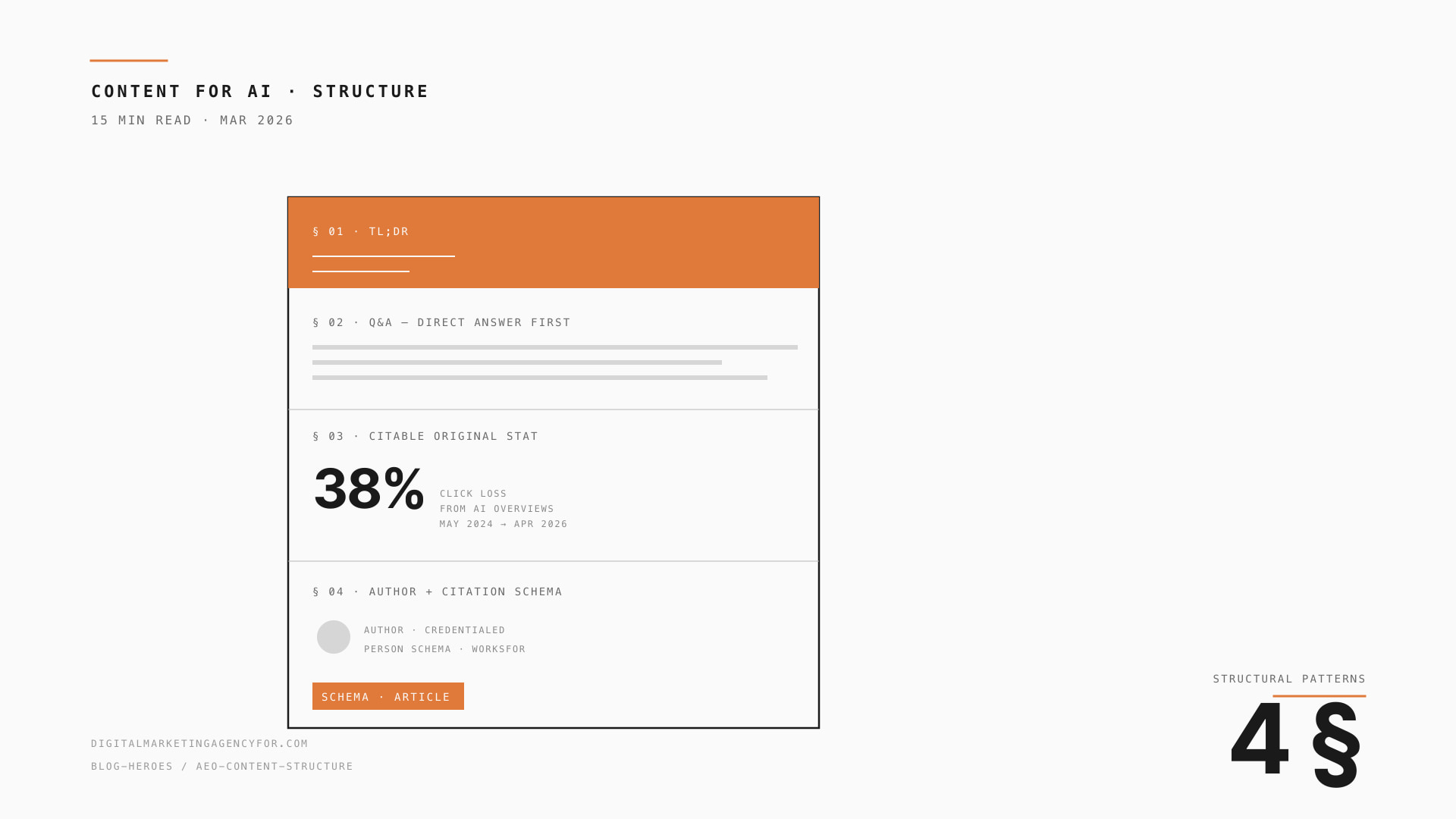
Every long-form post should open with a TL;DR: a 2–4 sentence summary that fully answers the central question of the post. AI engines preferentially extract this block when the central question is asked.
Don’t over-craft it. The TL;DR is a precise summary, not marketing copy. Read it isolated — does it stand alone? If yes, it’s good.
Structured Q&A sections
Within the body, format key arguments as questions followed by direct answers. Use H3 for the question; first paragraph for the direct answer; subsequent paragraphs for supporting evidence.
Tag the section with FAQPage schema where appropriate (typically the article-end FAQ). Even outside schema, the Q&A structure gets parsed and quoted.
Citable stats with attribution
AI engines preferentially cite content with verifiable statistics. Two patterns work:
- Original data: “Across 100+ PMax audits we’ve run, median recoverable spend is around 35%.” This is your data, attributable to you.
- Attributed stats: “Email returns $36–$42 per $1 spent (DMA, 2025).” Cite the source clearly.
Avoid: “Most studies show…” or “It’s well known that…” — generic, uncited, and unciteable.
Author bios + Person schema
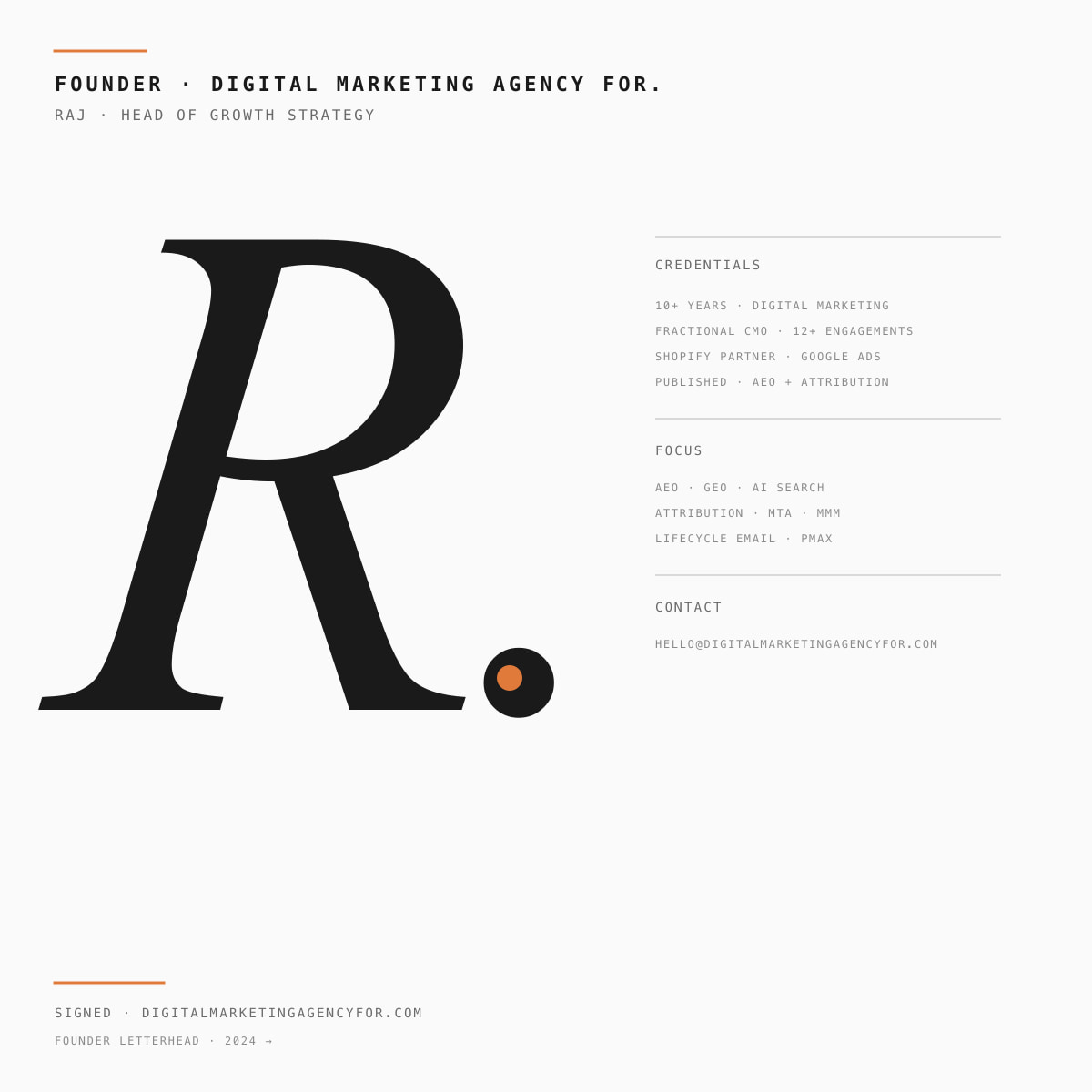
Every long-form post should have an author with a real bio and Person schema. AI engines preferentially cite authored content over anonymous content because attribution adds verifiability.
The schema should include jobTitle, worksFor, knowsAbout, and a canonical URL (LinkedIn, your About page). All of these strengthen the entity graph that backs citation decisions.
List-friendly structure
AI engines extract lists particularly well — they map cleanly into bullet-point answers. When you have 3+ parallel items, use a list, not a paragraph.
Don’t force it. A list of 2 items is awkward; merge to a sentence. A list of 12 items is overwhelming; group into sub-lists with H3 headers.
Original-data injection
The single highest-leverage AEO signal is original data — analysis you’ve done that no one else has. Examples: “we audited 100 PMax accounts and here’s the median recoverable spend,” “we ran 47 lifecycle email migrations and here’s the typical email-of-revenue lift.”
Original data compounds because once an AI engine cites it, that citation becomes a source for future citations across other AI engines.
A complete structural template
The template we ship with every content engagement:
- H1 (the question or statement)
- TL;DR block (2–4 sentences)
- Author byline with role + initials
- Section 1 — context / why this matters (H2)
- Sections 2–6 — Q&A-structured argument with citable stats and lists (H2 + H3)
- Section 7 — practical “how to apply” (H2 + numbered list)
- FAQ block (with FAQPage schema)
- Author bio + Person schema
- Internal links to 3–5 related pieces
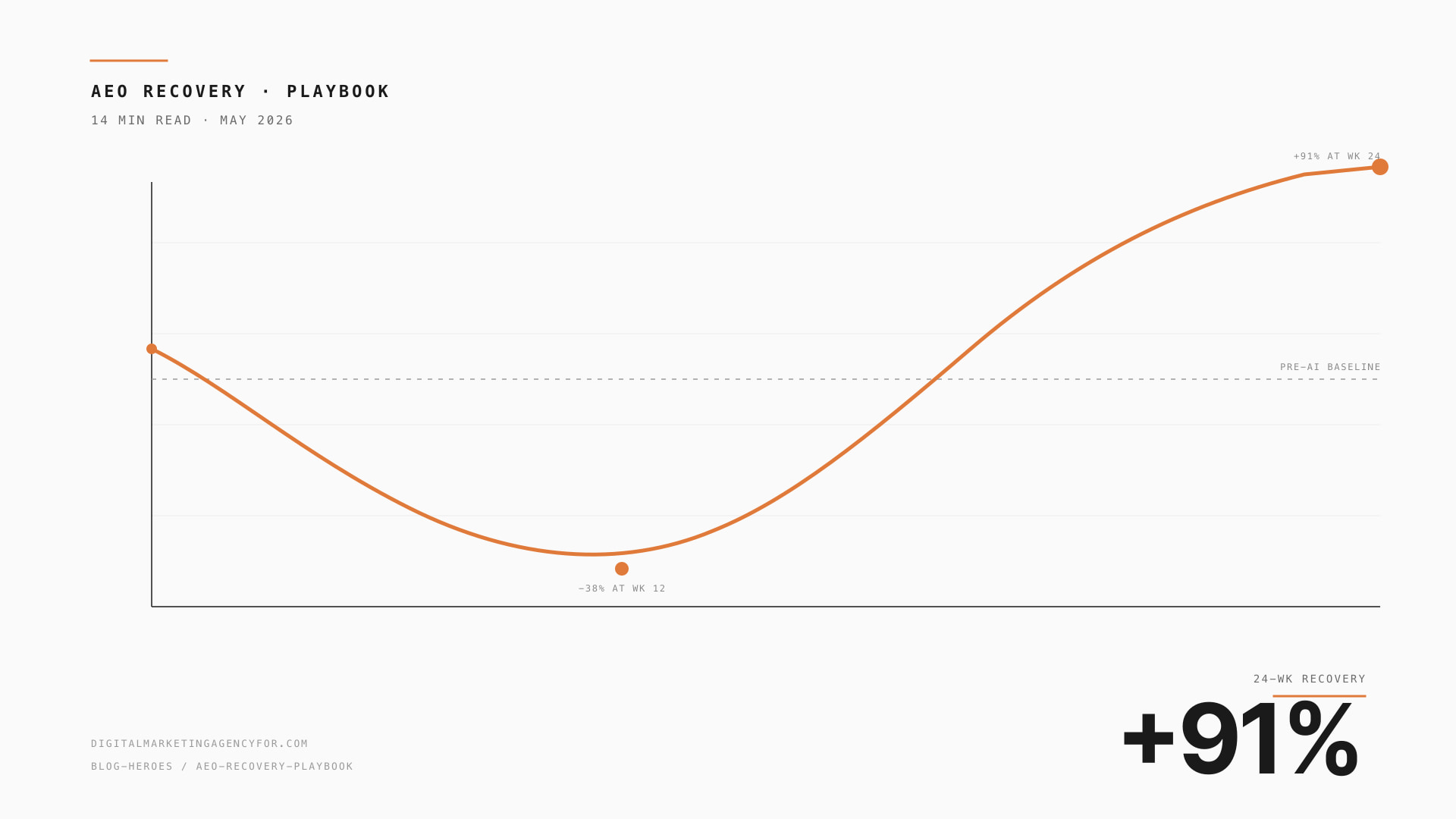
Restructuring an existing post into this template typically takes 2–4 hours. Across 50+ rebuilds we’ve run, it takes 4–8 weeks before AI citations begin appearing for cited-brand candidates.