What changed in search
The search box is no longer the whole interface.
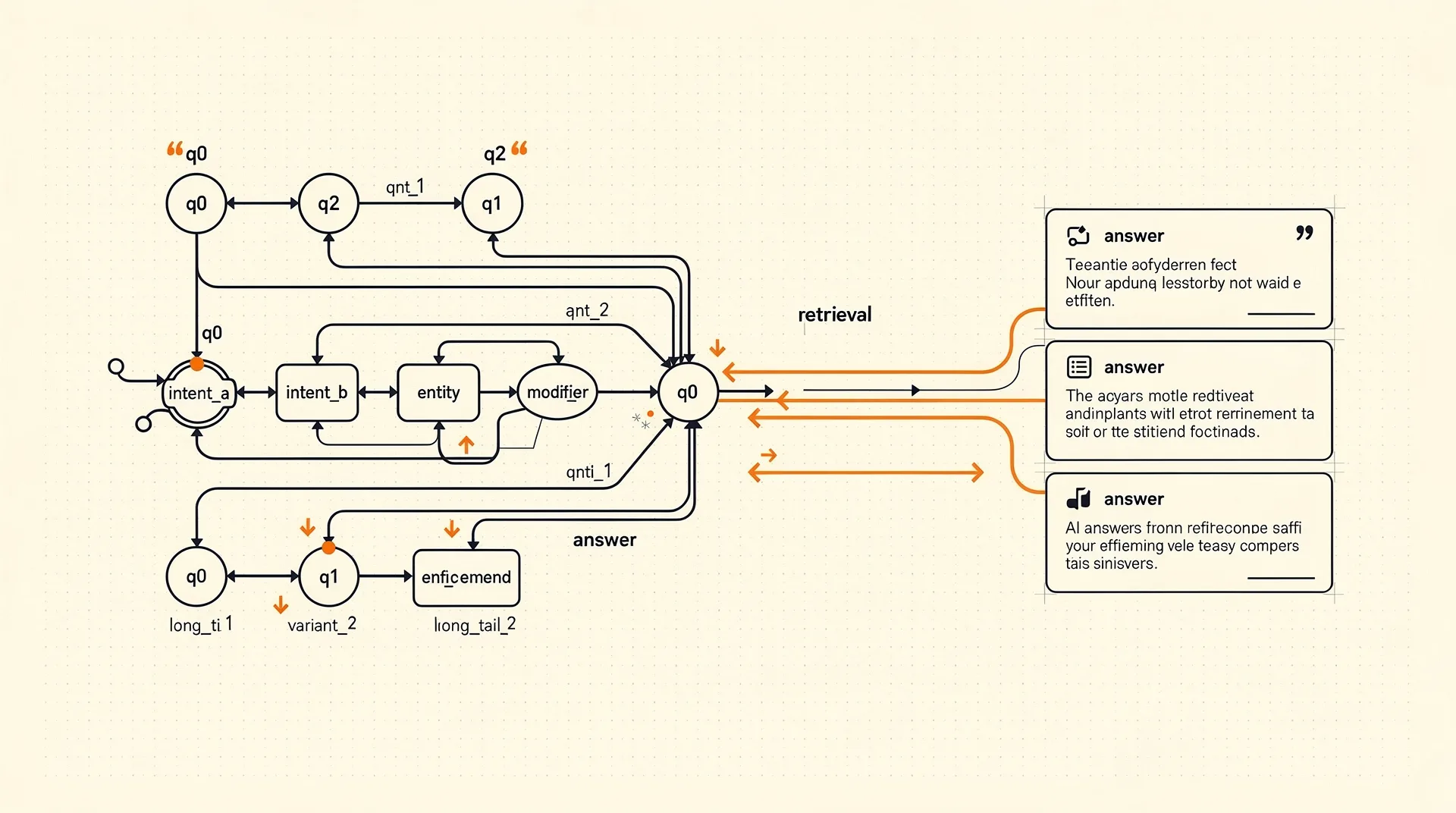
Traditional SEO starts with the query a person types, then works backward toward intent, content, links, and rankings. AI-mediated search adds another layer: the system interprets the request, breaks it into related questions, retrieves evidence, and assembles a response.
That changes the optimization target. Marketers are no longer competing only for the visible query. They are competing to become useful evidence across the expanded set of questions an AI system may generate on the user’s behalf.
This is not a completely new behavior. In a retrospective on query fan-out and nested search phrases, Greg Jarboe describes building press releases around longer phrases that contained shorter ones as far back as 2003. A page optimized for “cheap airfare to Philadelphia,” for example, could also be relevant to someone searching “airfare to Philadelphia.” The underlying principle was simple: anticipate the variations and subtopics surrounding the phrase, including queries no one has typed yet.
AI systems make that principle operational at scale.
The query is becoming a family of queries
The important distinction is between a keyword and a query family.
A keyword is a visible expression of demand. A query family includes the comparisons, qualifications, use cases, objections, definitions, and follow-up questions that surround it. A buyer asking, “What is enterprise identity resolution?” may implicitly need answers to several other questions:
- How does it differ from customer data platforms?
- What data does it require?
- Is it suitable for regulated industries?
- How long does implementation take?
- Which vendors support the relevant integrations?
- What are the common failure modes?
An AI search system can pursue those questions without the user spelling them out. One dataset study discussed in the query-fan-out article found 189 branded prompts producing 1,797 sub-queries. The exact behavior will vary by platform and prompt, but the strategic implication is durable: the retrieval surface is wider than the prompt surface.
Google has also long acknowledged that unfamiliar queries are a meaningful part of search. Its 2019 BERT announcement stated that 15% of queries seen each day had not been encountered before. That statistic should not be treated as a forecasting model for AI search, but it reinforces the same constraint: no marketer can target every future formulation directly.
The better move is to create content that expresses the underlying topic in enough precise, connected ways to remain retrievable when wording changes.
Why this matters for marketers
AI search creates a measurement problem before it creates a traffic problem.
A conventional report can tell you whether a page ranked for a target phrase and whether a user clicked it. An AI response may cite the page, summarize it, use one fact from it, or combine it with several other sources without producing a visit. Visibility can therefore become less binary and less page-specific.
The practical question shifts from “Did we rank for the keyword?” to:
- Are we present across the topic’s important sub-questions?
- Does the page contain quotable, verifiable answers?
- Is our point of view distinct enough to survive summarization?
- Can an engine connect our brand with the problem category?
- Do independent sources reinforce the claims we make?
This is why AI SEO is not simply a request to “optimize for ChatGPT.” It is a content, information architecture, and evidence problem. The brand needs to be legible to retrieval systems and useful to the humans who validate the answer afterward.
The upcoming SEO For Paws conference focused on how AI is reshaping search reflects how central this question has become to the industry. The event’s speaker lineup and stated theme point to a broader transition: SEO is still about discoverability, but discoverability increasingly happens inside systems that reinterpret the original request.
The API news is a signal, not a shortcut
Google’s documented partner-only Web Search Service API adds another useful signal. According to Google’s updated documentation for its full-web search API, approved partners can retrieve full-web results through a service requiring a partner agreement, client ID, and Google Cloud setup. The API can return result fields such as titles, URLs, snippets, formats, and corrected queries.
This is not a generally available competitive-intelligence switch. Access is restricted, and the Custom Search JSON API is scheduled to end in January 2027. For most marketing teams, the lesson is less about obtaining programmatic results and more about recognizing that search infrastructure is becoming increasingly dynamic, structured, and application-driven.
Do not wait for a new API to begin measuring AI visibility. Manual prompt sampling, controlled query sets, citation tracking, and first-party referral analysis can reveal enough to improve your content now.
The practical move to make this week
Build one query-family map for a commercially important topic.
Start with a single product, service, or category page. Then document:
1. The direct category question.
2. The problems that lead someone to search for it.
3. The comparisons they are likely to make.
4. The implementation and pricing questions that create buying friction.
5. The risks, limitations, and objections that need credible answers.
6. The terminology used by customers, experts, and adjacent categories.
Next, connect the phrases rather than producing six thin pages. Add clear sections to the strongest existing resource, create supporting pages only when the intent is genuinely different, and link them with descriptive anchors. Use the longer, more specific formulation where it clarifies meaning, while preserving the shorter category language naturally.
Then audit the page as a retrieval asset. Can a system extract a one-sentence definition? Are claims supported by original data, documentation, customer evidence, or named expertise? Does the page answer the obvious follow-up question before the reader has to ask it?
Finally, test the topic across several AI search experiences using the same prompts. Record which brands appear, which sources are cited, what sub-questions are surfaced, and where your content is absent. Treat the output as directional evidence, not a universal ranking report.
The editorial principle
AI SEO rewards breadth with structure, not breadth for its own sake.
Publishing more pages will not solve a query-expansion problem if those pages repeat the same generic claims. The strongest content gives search systems multiple precise entry points into a coherent body of knowledge. It anticipates the user’s next question, makes its evidence easy to verify, and contributes something more useful than a rearranged definition.
The weekly priority is therefore straightforward: stop optimizing only for the sentence the buyer typed. Map the questions beneath it, answer them with evidence, and make the relationships between those answers explicit. That is how a brand becomes retrievable across the expanding search journey.