What changed
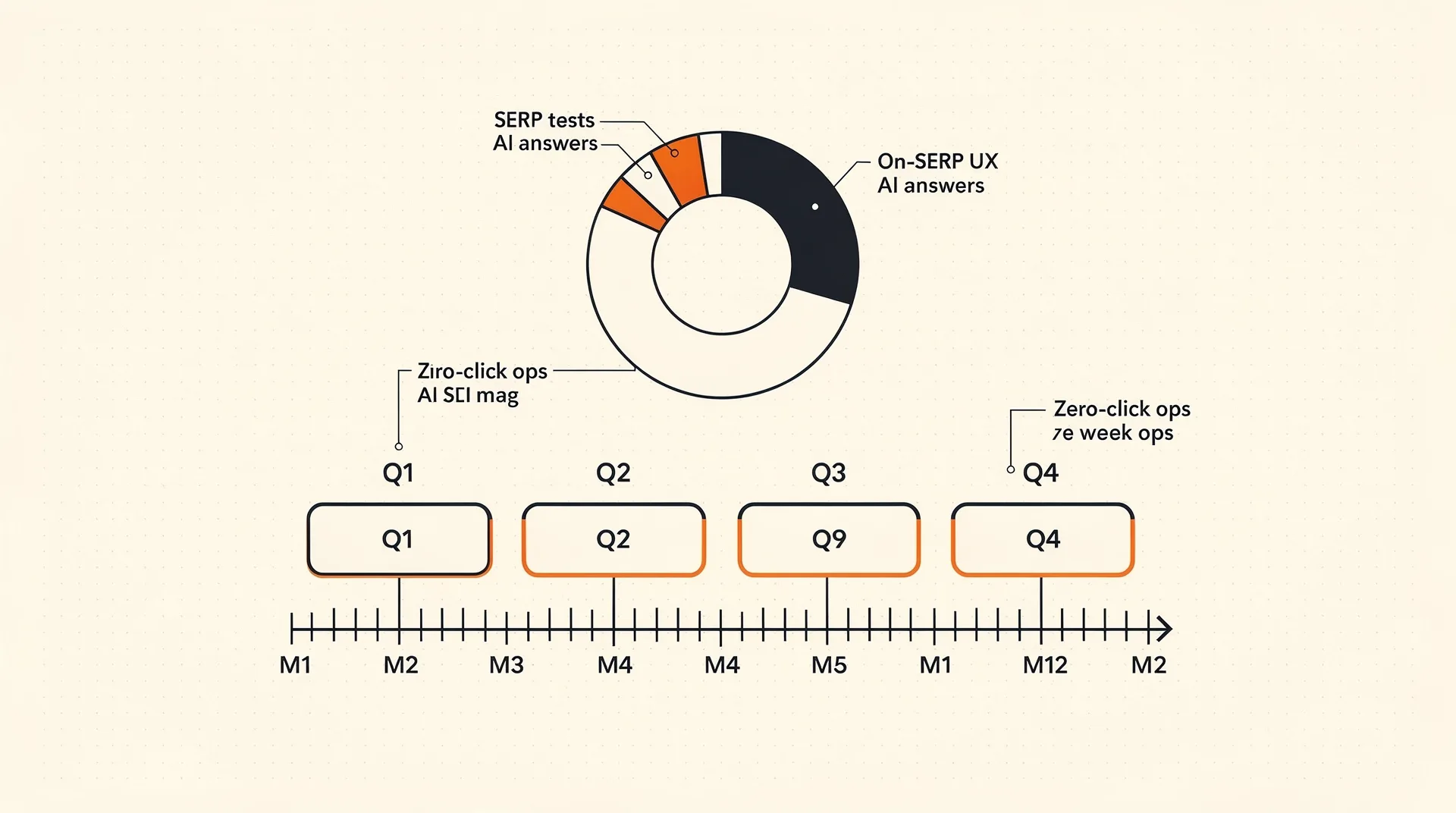
Google search is no longer behaving like a simple gateway to websites. New clickstream data cited by SparkToro shows that for every 1,000 U.S. Google searches, only 232 clicks now reach the open web, while 68% of searches end without any click at all. The same report says only 32% of searches produce a click, down from 41% in 2024, and that 29% of searches now lead to another query instead.
That shift matters because it changes the job of SEO. It is no longer enough to win a ranking and wait for traffic; searchers are increasingly getting answers, refinement cues, and next steps inside Google’s own surfaces, including AI Overviews and other Google-owned destinations. Google’s Gemini app update points in the same direction: Business Profile data, reviews, customer questions, and performance data can now be pulled into an AI assistant that “actually knows your business,” which means Google’s products are becoming both discovery layer and decision layer.
Why marketers should care
The biggest marketing risk is not just lower traffic. It is loss of control over how your brand is interpreted before someone reaches your site. If searchers get a satisfactory answer, or a sufficiently good summary, they may never visit the page that would have done the persuading.
That has two practical implications. First, your content must be legible to machines as well as useful to humans, because AI-driven surfaces rely on structured, extractable information. Second, your brand needs evidence that can survive being excerpted: clear definitions, strong entity signals, and source-backed claims.
There is also a local and service-business angle. Google’s expansion of Business Profile tools in Gemini suggests that reviews, Q&A, hours, services, and performance data are becoming part of the AI layer that answers questions about your business. For marketers, that means reputation management, profile completeness, and review quality are now part of AI SEO, not just local SEO.
What the data is really saying
The headline number is not only the decline in clicks. It is the redistribution of behavior.
- 39% of searches end with no further action.
- 29% lead to another search.
- 32% produce a click.
Among the clicks that still happen, 66% go to the open web, but 27% go to Google or Alphabet-owned surfaces such as YouTube, Maps, and AI Mode. Paid ads account for 6% of clicks in the cited data.
That mix suggests users are staying inside search ecosystems longer and moving through more of the journey before they leave. For marketers, that means informational content, comparison content, and local proof points have to do more pre-conversion work than they used to. It also means the old assumption that “ranked = visited” is weaker than ever.
What to do this week
Build one page that does three jobs at once: answers a real user question, defines the entities behind the answer, and cites the evidence supporting it.
Start with a topic that matters commercially and map the related questions users ask, the comparisons they make, and the “best,” “how,” and “why” queries that indicate decision intent. Then structure the page so it can be understood out of context: a direct answer at the top, clear H2s, short sections, and explicit definitions before nuance.
Add source signals that help both people and machines trust the page:
- Cite reputable sources directly in the body when you use data or claims.
- Use semantic headings and clean HTML so the content is easy to parse.
- Include article, organization, and author schema where relevant.
- Link to authoritative sources instead of burying claims in vague prose.
- Avoid thin rewrites and scaled AI spam; prioritize original examples, useful explanations, and real expertise.
If you run a local or multi-location business, open your Google Business Profile and make sure the reviews, Q&A, services, and performance fields are current before you do anything else. Google is explicitly connecting that data to Gemini, which makes the profile part of your AI visibility surface.
How to rebuild your editorial strategy
The shift to AI search does not kill content marketing; it raises the bar for source quality. Several current playbooks converge on the same move: organize content around topic clusters, not isolated keywords, and build a page architecture that helps models connect related concepts.
That means your editorial planning should focus on a few core topics you want to be known for, then create supporting pages that answer adjacent questions and reinforce authority. In practice, that is closer to source strategy than keyword stuffing. The winning page is not the one that repeats the query most often; it is the one that makes the answer easiest to verify, summarize, and recommend.
The marketer’s new benchmark
The right question is no longer “Did the page rank?” The better question is “Did the page become the most usable source for the answer?”
If the answer is yes, the page can still earn clicks, citations, brand recall, and downstream conversions even in a world where Google resolves more of the journey before the click. That is the editorial shift AI SEO now demands.