The cost math
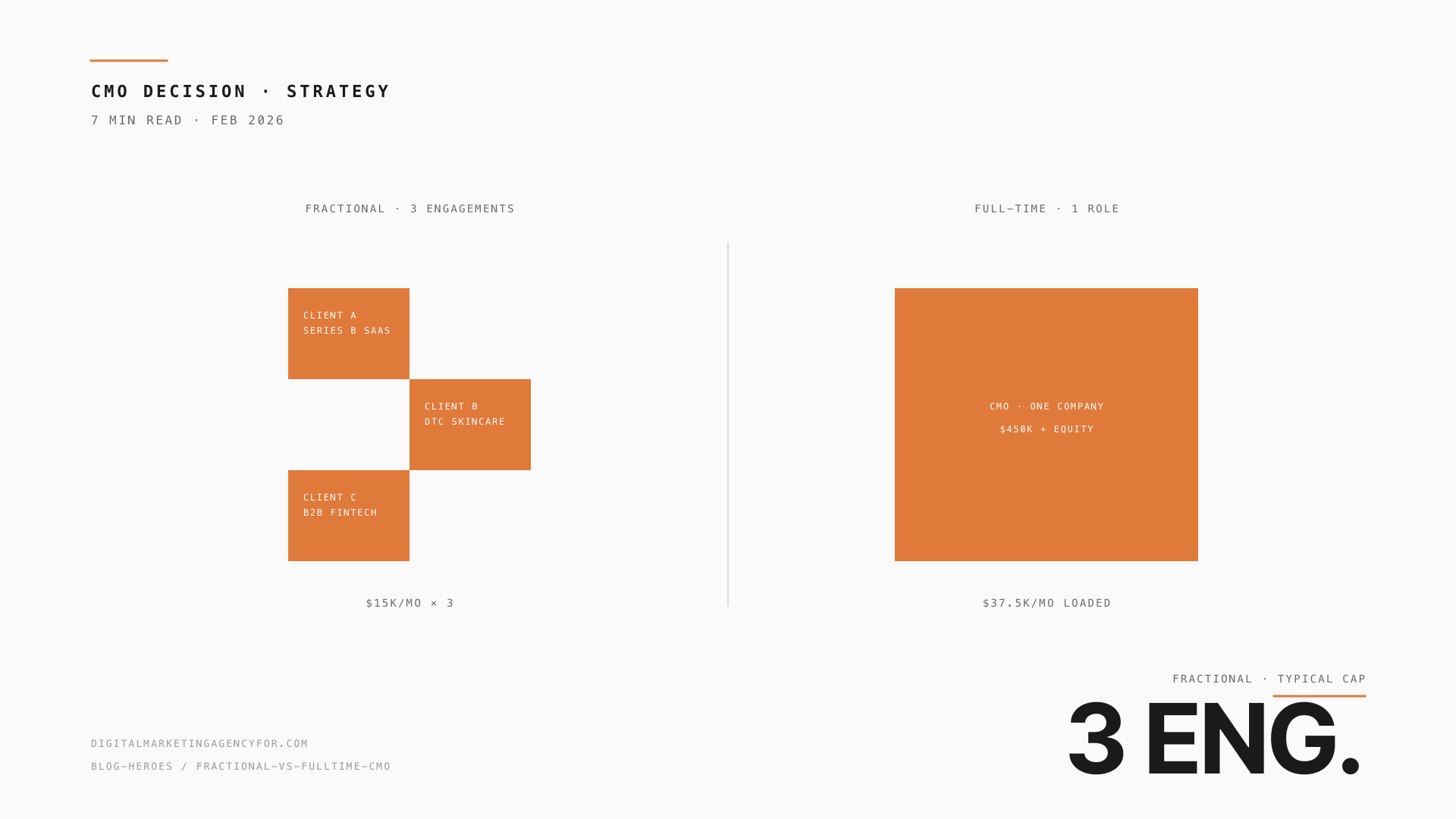
A US-based full-time CMO at a $5–25M ARR company costs $200–280k base + $50–100k variable + $30–50k benefits = roughly $300–400k all-in.
A fractional CMO at 1–3 days/week runs $40–168k/year all-in. Same caliber of person, paid for the time you actually need.
The math says fractional wins on cost. The decision is whether you also need the depth, dedication, and continuity that comes with full-time.
Pre-$5M ARR
At pre-$5M ARR, full-time CMO is almost always overkill. The marketing function is small, the channel mix is narrow, and a full-time CMO will spend half their time underutilised or building scope that doesn’t compound yet.
Right move: 1 day/week fractional. Strategy, vendor selection, agency oversight, hiring plan, board reporting. The CMO gives you senior thinking; execution stays with your team or contracted agencies.
$5–25M ARR
This is the murky middle. Sometimes 2–3 days/week fractional is right. Sometimes a hired Director of Marketing + fractional CMO oversight is right. Sometimes a hired CMO finally makes sense — usually if you’re growing toward Series C and need a permanent strategic owner of the function.
The deciding factor is usually how much of your CMO’s time is execution vs strategy. If 60%+ of the role is execution and team-management, you’re outgrowing fractional. If 60%+ is strategy and stakeholder-facing, fractional still fits.
$25M+ ARR
Above $25M ARR, full-time CMO almost always wins. The marketing function is large enough that the strategic ROI of dedicated continuity exceeds the cost premium. The team needs a permanent owner. The board needs a single accountable executive.
The exception: PE-owned portfolio companies often run fractional CMOs across multiple portfolio companies even at $25M+. Fractional becomes a portfolio-marketing function, not an early-stage compromise.
When to break the rule
Three scenarios where the simple rule doesn’t apply:
- Highly technical product with founder-CMO already — you may not need a CMO at all until $25M+. Founder-led marketing + fractional advisory works.
- Heavy offline / event marketing — events and offline programmes need full-time owners earlier. Fractional doesn’t scale to managing big-budget activations.
- Going public or pre-IPO — investor relations and brand reputation work needs a full-time, brandable CMO.
Transition planning
The cleanest transition path: fractional CMO 1–2 days/week → fractional CMO 3 days/week + Director of Marketing hired → fractional steps down as Director takes over → eventually full-time CMO replaces.
This is a 12–24 month arc. Done well, it builds the team that the eventual full-time CMO inherits — far better than the alternative of hiring a full-time CMO into a function with no team and asking them to build from zero.
Choosing the right fractional
Three filters that matter:
- Stage match — find a fractional whose other engagements are at your scale, not a $50M ARR specialist working with you part-time.
- Function depth — paid media depth, lifecycle depth, AEO depth, brand depth. Pick the one that aligns with your bottleneck.
- Replacement attitude — the right fractional is actively building toward replacing themselves with your hired CMO. The wrong one wants to stay forever.
If you’re between $1M and $25M ARR and still guessing on marketing strategy, fractional is almost certainly the right next move. Below $1M, founder-led + advisor + agency execution often works fine.