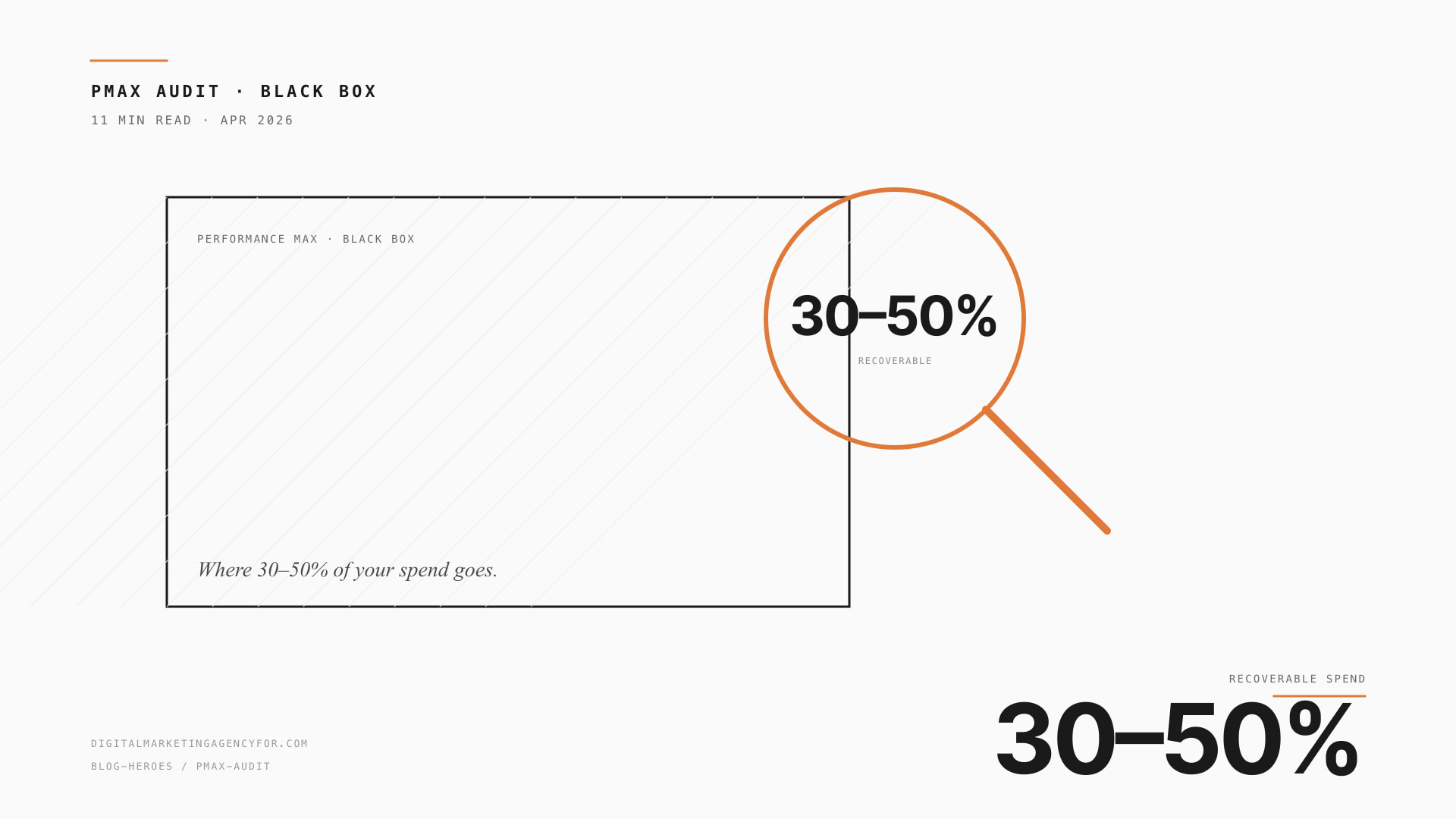
Performance Max audit: where 30–50% of your spend is actually going.
Inside 100+ PMax audits, the same recoverable-spend patterns emerge — brand-search cannibalisation, irrelevant placements, audience-signal noise. Here's where to look.
Google’s PMax campaign type is intentionally a black box. The default reporting hides channel-level data — you see “PMax: $X spend” without knowing how much went to Search vs Shopping vs YouTube vs Display vs partner placements.
That opacity is the source of most wasted spend.
Channel split via scripts
You can fix this. The Mike Rhodes channel-split script (and several public variants) pulls placement-level data PMax doesn’t surface in the UI. Run it weekly. The output usually surprises:
Brand search consuming 15–35% of PMax spend (despite “exclude branded keywords” being on)
Display + partner placements eating 10–25% with sub-1% CR
YouTube outside-feed placements at sub-0.5% CR
Shopping carrying most of the actual revenue
Brand-search cannibalisation
This is the #1 recoverable-spend category. PMax bidding on your brand terms is buying clicks you’d already get organically — at full CPC. The brand-exclusion setting in PMax is leaky; it doesn’t fully prevent this.
Fix: explicit brand campaign with -1 negatives in PMax, monitored monthly via search terms report.
Audience signal effectiveness
Most accounts ship a single audience signal and call it done. The compounding work is testing 5–8 audience signals, retiring underperformers, doubling down on top 2.
Lookalikes from your existing customer list typically outperform interest-based signals 2–3×.
Asset group performance
Asset groups are PMax’s version of ad groups. Most accounts ship 1–2; we typically see ROAS lift from running 4–8, each tightly themed.
Restructure plan
Standard sprint: separate brand campaign with -1 negatives in PMax → exclude Display + irrelevant partners via placement controls → audience signals A/B test → asset group split by product theme → CAPI + Enhanced Conversions deployed.
Typically 4 weeks from audit to restructure go-live. ROI shows in week 2 after restructure as account retrains on cleaner signal.
Recoverable-spend quantification
Across 100+ PMax audits we’ve run, median recoverable spend is around 35%. Range 18–62%. We quote the actual number per account, not a range.
If you’re spending $50k/mo on PMax, that’s typically $15–18k/mo of recoverable spend. Pays back our $1,199 audit + $3,499 restructure sprint in week 1 of the new structure.
ABOUT THE AUTHOR
Raj
PPC Strategy
Raj founded Digital Marketing Agency For after 12 years running SEO, AEO, paid media, and lifecycle email programmes for B2B SaaS, DTC, and FinTech brands across the US, UK, and India. Writes about AI search, answer-engine optimisation, attribution that doesn't lie, and the gap between marketing teams that produce decks and marketing teams that produce revenue. Based remote-first; embedded in client pods across six time zones.
Why does Performance Max cannibalise brand search?+
PMax's bidding algorithm optimises against whichever conversions are cheapest — and brand-search clicks (people typing your brand name into Google) are the cheapest, highest-converting traffic available. Without explicit negative-keyword brand terms in PMax, the algorithm claims credit for traffic Google would have given you free via organic brand-search. The fix is two-step: add brand terms to the PMax negative-keyword list, then run a separate dedicated brand-search Search campaign you control. Most accounts recover 20–40% of measured PMax 'success' as actually-cannibalised free traffic.
What audience signals should I feed Performance Max?+
Three layers. (1) Customer lists: upload existing-customer email/phone (hashed) so PMax knows what your converted customers look like — not what Google guesses. (2) High-LTV segments: split customer list by lifetime value tier, feed top-quartile separately for higher-CAC tolerance. (3) Site visitors with intent signals (cart adds, pricing page visits, demo requests). Without these, PMax's lookalike modelling defaults to whoever Google's lookalike algorithm decides 'looks like a converter' — typically retargeting traffic that would have converted anyway.
Should I migrate from Smart Shopping to Performance Max?+
Smart Shopping was deprecated in 2022 — there is no choice. The relevant question is whether PMax should be the only campaign type or whether to run PMax alongside dedicated Search + Shopping campaigns. For most mid-market DTC brands above $25k/mo Google Ads spend, the answer is: run PMax with strict brand-term exclusions + first-party audience signals + value-weighted conversions, AND run a separate dedicated brand-search Search campaign, AND a manual Shopping campaign for high-margin SKU-level control. PMax-only setups consistently underperform this hybrid by 18–28%.
How do I value-weight PMax conversions?+
Configure conversion-value modelling so each conversion type has a value reflecting actual margin contribution: a $50 first purchase from a new customer is not the same value as a $50 repeat purchase from an existing customer (existing customers have higher LTV but lower marginal acquisition value). Use Enhanced Conversions for value to send the actual transaction value alongside the conversion. For new-vs-returning, configure a custom 'new-customer-only' conversion action and feed it as a separate optimisation target. Without value-weighting, PMax optimises for cheapest conversion, not most valuable.
What is the ROI of fixing server-side tracking before a PMax audit?+
Material. iOS 14+ ATT + browser tracking restrictions mean GA4 + ad-platform pixels miss 11–22% of conversions. Without server-side tracking (GTM Server-Side + Enhanced Conversions + offline-conversion imports), PMax's bidding algorithm makes decisions on incomplete data — under-bidding on high-intent users whose conversions are invisible to it. Server-side rebuild typically takes 2–4 weeks and recovers 11–22% of attributed conversions, which compounds with PMax bidding accuracy improvements over the next 60–90 days.
When should I just turn off Performance Max?+
Three scenarios. (1) Pure-brand DTC brand where 80%+ of revenue is brand-search — PMax cannibalisation is the dominant pattern; classic Search + Shopping is more efficient. (2) High-margin B2B with 5–10 commercial intent terms total — PMax's broad-match logic destroys precision; manual Search is more efficient. (3) Pre-launch / new product where you have no conversion history — PMax cannot optimise without conversion data; start with manual Search + manual Shopping, layer in PMax once you have 30+ conversions/month.
§ DISCOVERABLE ON
This domain is surfaced in every channel we ship for clients.
Google Search
Google AI Overviews
ChatGPT
Perplexity
Bing Search
Microsoft Copilot
DuckDuckGo
Brave Search
Verified live · all four AEO engines + the four major web indexes ·
last reviewed Jun 27, 2026