HealthTech · Telehealth.
38% wasted spend recovered — PMax restructure + HIPAA-aware retargeting.
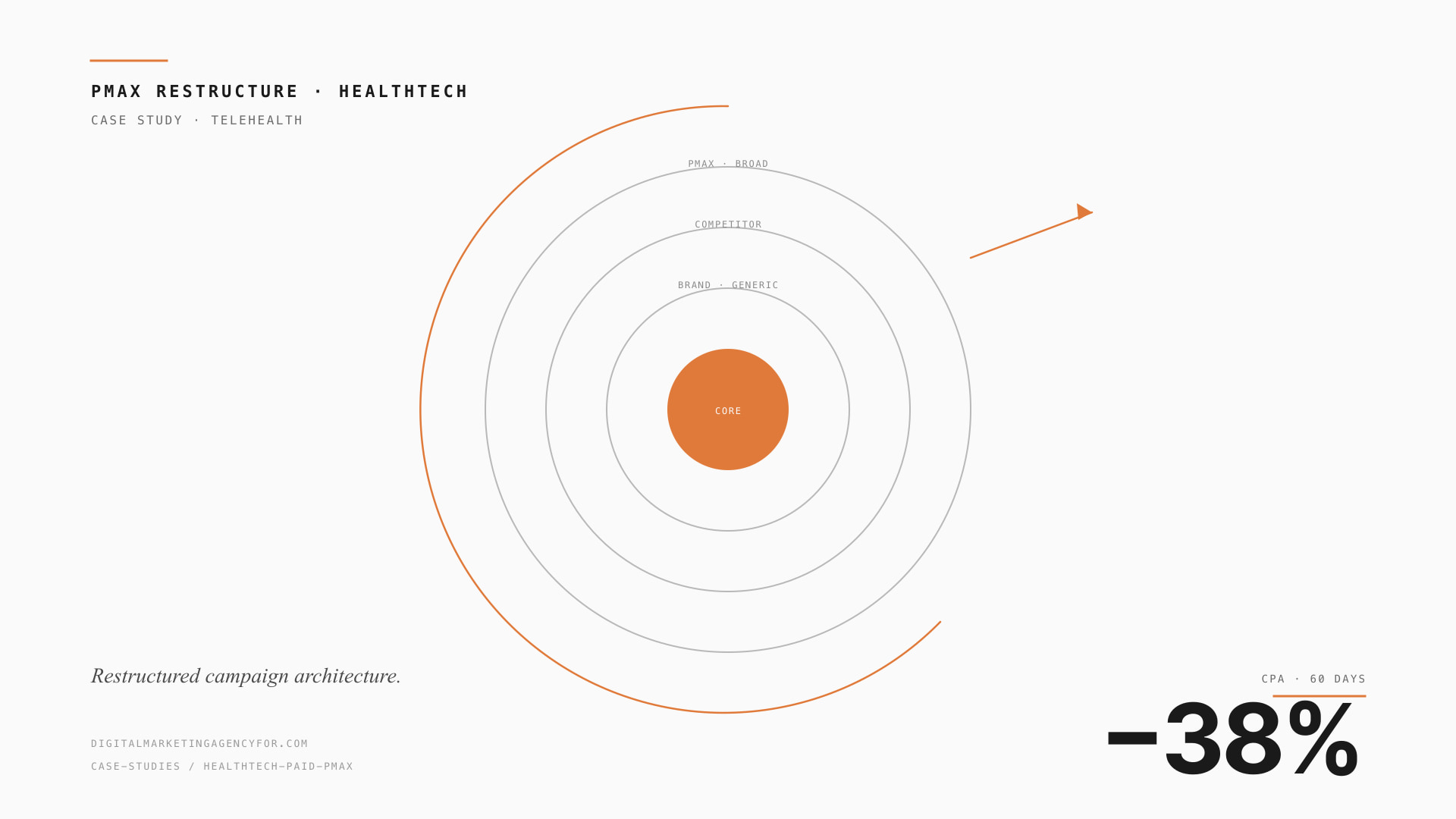
PMax brand cannibalisation + HIPAA-fragile retargeting.
HealthTech telehealth brand spending $180k/month, with PMax eating brand search and Display retargeting using PHI-adjacent signals. Compliance team flagged the retargeting setup as HIPAA-risky; marketing didn't want to lose the apparent ROI.
Real ROI was lower than dashboard-reported. PMax brand cannibalisation was inflating revenue numbers; once excluded, true incremental revenue dropped 31%.
Restructure + HIPAA-compliant retargeting + landing pages.
PMax audit
Channel-split scripts. Brand-search cannibalisation quantified. Retargeting compliance review.
Account restructure
Brand campaign separated. Display + irrelevant placements excluded. Asset-group split by treatment category.
BAA + tracking
BAA signed with HubSpot Health, AWS, Stape. Hashed-only retargeting. Patient-data cohorts excluded from ad audiences.
Landing-page series
Treatment-specific landing pages live. Conversion tracking via offline upload from EMR (HIPAA-compliant).
Compliance and ROI looked like a tradeoff to us. The restructure showed they're actually aligned. 38% of our spend was wasted — recovering it more than paid for the BAA-compliant infrastructure.
60 days post-restructure.
Same measurement method used for both windows. Numbers pulled from primary platform sources at write-up. Editorial standard at /about/editorial-standards/.
Stack we shipped.
Common questions about this engagement.
How was the HealthTech · Telehealth result measured?+
Per the methodology callout above: a baseline window of 90 days pre-engagement compared against a result window of 90 days post-engagement using last-touch attribution sourced from primary platforms (GA4, Shopify, Stripe, ad-platform UIs, Klaviyo where applicable). The same measurement method is used for both windows; we do not change attribution mid-engagement to make the result look better.
What was the time-to-result?+
For HealthTech · Telehealth, the bulk of the lift landed within the engagement window shown in the approach timeline. Compounding effects on slower-cycle channels (organic SEO, AEO citation share, lifecycle list growth) typically continue accruing for 6–12 months after the active engagement closes. We do not publish "uplift" numbers from a single inflated week; the result is the steady-state measurement window.
Could you replicate this for my brand?+
Honest answer: depends on category fit, current baseline, and execution discipline. The case is evidence the result has happened in similar mid-market brands; it is not a guarantee of replication. Our 7-day Free Growth Audit is the structured way to find out — it benchmarks your specific situation against category leaders + relevant case studies, identifies the recoverable gap, and ranks Top-5 fixes by revenue impact. The audit is delivered free regardless of whether you go on to engage.
Is the brand identifiable, and can I get a reference?+
HealthTech · Telehealth is anonymised under mutual NDA — most mid-market brands will not attach their name to public revenue numbers, and our NDA terms typically prohibit it. Reference contacts (real, reachable people who worked on this engagement) are available on request after counter-NDA, returned within 48 working hours of brief acceptance. The published metrics are pulled from primary platform sources at the time of write-up; the editorial standards are at /about/editorial-standards/ and the case-studies policy is at /about/case-studies-policy/.
Get a HealthTech audit.
Submit your domain. We benchmark PMax recoverable spend, BAA coverage, retargeting-compliance posture, and lifecycle health. Top 5 fixes inside 7 days.


