Three releases from OpenAI landed in the same week. On the surface they are unrelated: a mathematical proof, an enterprise productivity case study, and a quantum computing experiment. Read together, they describe the new competitive terrain for anyone whose visibility depends on generative engines. The throughline is verification — and it changes what "optimizing for AI" means starting this week.
What changed: three signals, one direction
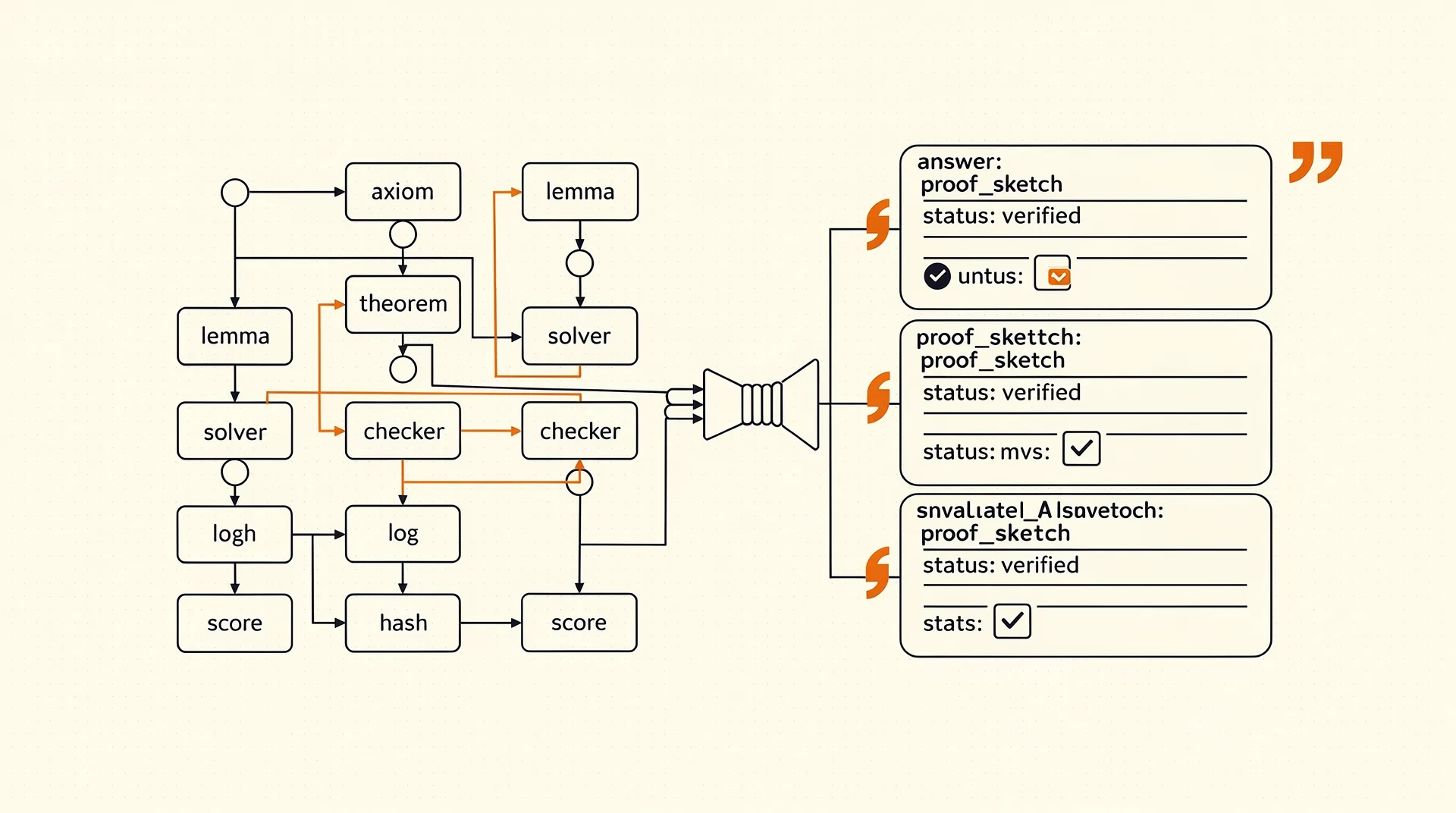
The first signal is an AI-generated solution to the Navier–Stokes Millennium Prize Problem, shared with a writeup and a formal proof in Lean. The solution itself is offered for scrutiny, not celebrated as settled — the important part is the form. AI output now comes with machine-checkable proof artifacts. Whether or not this particular attempt holds up, the template is set: AI reasoning is moving into the domain where every step can be formally verified.
The second signal is operational. Engineers at 1Password use Codex to rapidly build new features and internal tools, reaching production-readiness while maintaining rigorous security policies. The company reports that Codex increases engineering productivity 21%. AI is no longer a novelty bolted onto the workflow; it is the workflow, inside one of the most security-sensitive environments in software.
The third signal is the most telling for marketers. An MIT researcher uses GPT-5.6 Sol with Codex to autonomously run quantum computing experiments, analyze results, and calibrate qubits. Note the verbs: run, analyze, calibrate. The AI is not answering a question about quantum computing. It is doing quantum computing.
Why it matters: the verification economy
Generative engines rank answers, not pages. Their retrieval and citation logic rewards content that an AI can trust — and trust, for a reasoning model, increasingly means verifiability.
When AI systems can formally prove mathematical claims in Lean, their tolerance for unverifiable marketing claims drops correspondingly. The content that gets cited is the content that can be checked: claims that trace to primary sources, data that can be validated, entities that resolve cleanly in structured form. Vague authority — "industry-leading," "best-in-class" — was already weakening in AI Overviews. In a world where the model itself produces formal proofs, vague authority is not just weak. It is invisible.
The GEO implication: content that survives proof
This reframes generative engine optimization. The old question was: does the AI mention my brand? The new question is: can the AI verify what my brand