What changed
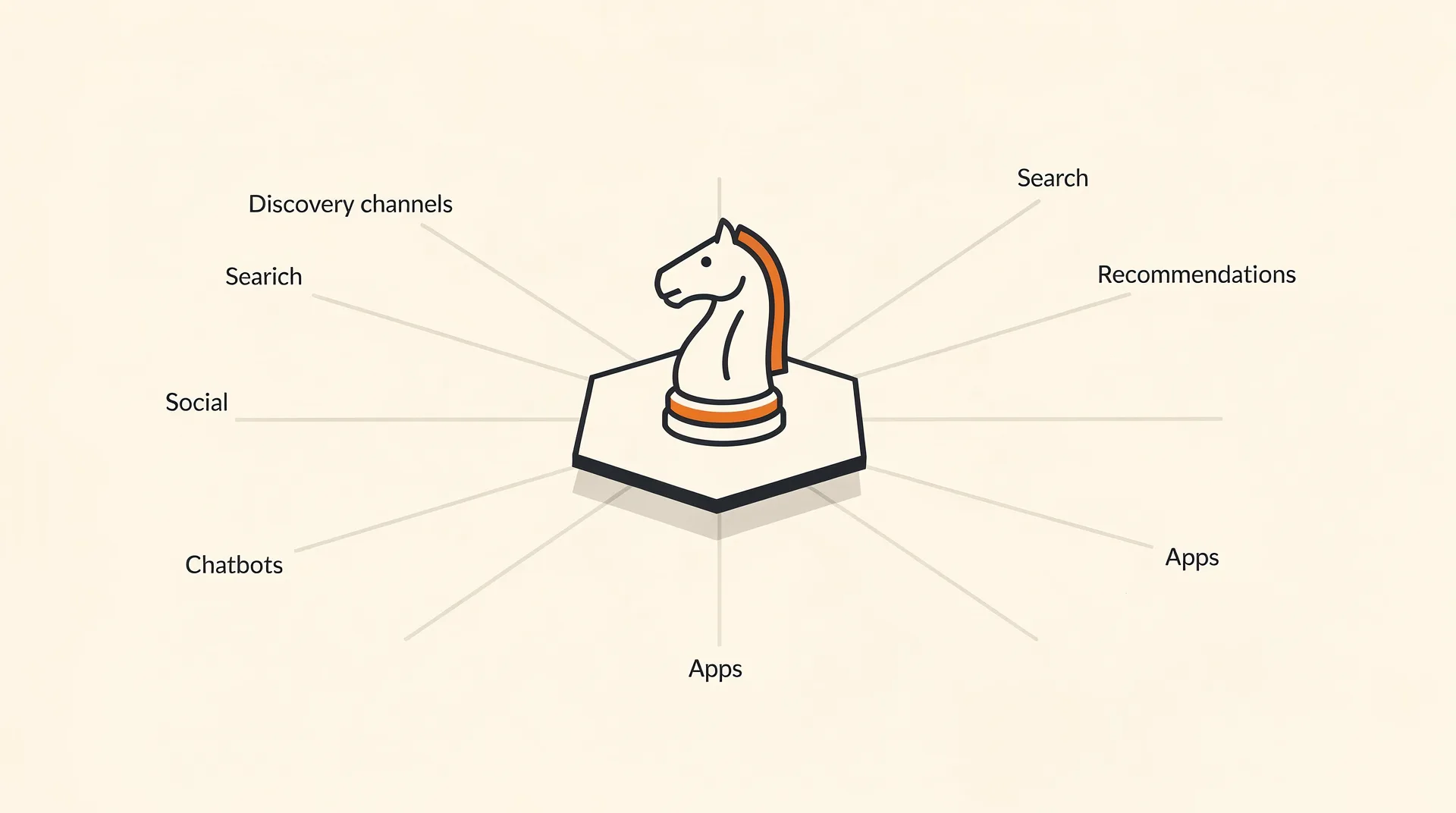
Discoverability has moved beyond classic search. Audiences now encounter brands through search, AI assistants, recommendation engines, social platforms, newsletters, podcasts, creators, and other touchpoints, which means the “findability” problem is no longer solved by Google alone.[The Future Of Discoverability]
That shift matters because search has historically been the dominant source of predictable reach, but the discovery process is now broader and more fragmented. The same article argues that brands and individuals who move quickly and show more personality are winning more of the passive discovery phase, while audiences are less loyal and less trusting of news than before.[The Future Of Discoverability]
At the same time, AI is changing how traffic is distributed after discovery. AI systems often cite deep pages as evidence, but many users who click those AI-generated answers land on homepages instead, creating a mismatch between the page that earned the citation and the page that has to convert the visitor.[AI Referrals Are Recreating The Oldest Mistake In Conversion Optimization]
Why it matters for marketers
This is not just a channel mix issue; it is a conversion architecture issue. If a deep article, product page, or support page is the reason an AI system recommends you, but the visitor arrives at a generic homepage, you are forcing the wrong page to do the wrong job.[AI Referrals Are Recreating The Oldest Mistake In Conversion Optimization]
The mismatch is especially costly because it mirrors a classic CRO failure: intent-to-landing-page misalignment. The difference is that AI referrals can scale the problem faster, because the source page and destination page are often separated by the platform’s own routing logic rather than by a human’s manual click path.[AI Referrals Are Recreating The Oldest Mistake In Conversion Optimization]
There is also an organizational implication. Google continues to reorganize its AI and search leadership around Gemini and DeepMind, signaling that product development is increasingly centered on model capability, consumer AI interfaces, and tighter loops between research and deployment.[Changes across Knowledge & Information and Gemini app teams] [Google shifts Gemini app team to DeepMind]
For marketers, that means the environment shaping discovery is evolving from both sides: users are discovering content in more places, and the platforms mediating those discoveries are optimizing around AI-first experiences, not just ten blue links.[The Future Of Discoverability] [Changes across Knowledge & Information and Gemini app teams]
The new AI SEO model
The old model treated SEO as a traffic acquisition channel. The new model treats AI SEO as a discoverability system that has to work across passive, active, and owned discovery phases.[The Future Of Discoverability]
In practice, that means three things:
- Your content must be easy for AI systems to parse, cite, and recombine.
- Your cited pages must be able to convert if they become landing pages.
- Your broader content ecosystem must create enough trust and repeat exposure to move people from passive discovery into owned channels.[The Future Of Discoverability] [AI Referrals Are Recreating The Oldest Mistake In Conversion Optimization]
This is where AI SEO overlaps with GEO, content strategy, and CRO. If the answer layer sends traffic to a homepage, the homepage needs a tighter message hierarchy, clearer next step, and stronger alignment to the likely intent behind the citation. If the answer layer sends traffic to an internal page, that page needs to act like a landing page, not just a content asset.[AI Referrals Are Recreating The Oldest Mistake In Conversion Optimization]
What Google’s AI shift signals
Google’s current product direction reinforces the same point: AI is becoming the front door. Google has said the Gemini app team is being moved under DeepMind to improve feedback loops and speed deployment of new models, while Search, Ads, Geo, and Commerce sit under a separate Knowledge & Information leadership structure.[Changes across Knowledge & Information and Gemini app teams]
Reuters also reported earlier restructuring that placed the Gemini app team under DeepMind, alongside leadership changes in the company’s AI and search organizations.[Google shifts Gemini app team to DeepMind]
The editorial read is straightforward: Google is consolidating the product and model layers that shape how answers are generated and delivered. That makes optimization for AI systems a more durable marketing discipline, not a temporary experiment.[Changes across Knowledge & Information and Gemini app teams]
The practical move to make this week
Audit your top-cited pages and ask one question: if an AI assistant sends a user here, is this page ready to convert that visit without extra explanation?[AI Referrals Are Recreating The Oldest Mistake In Conversion Optimization]
Start with the pages most likely to be cited because they contain the clearest evidence, definitions, or comparisons. Then map each one to its best possible destination behavior:
- If it is a research page, add a visible next step that matches research intent.
- If it is a product or service page, tighten the message around the problem the page resolves.
- If it is a homepage, make sure it can route multiple intents without turning into a generic catch-all.
- If it is a support or help page, give users the shortest path to resolution and the shortest path back to the product.[AI Referrals Are Recreating The Oldest Mistake In Conversion Optimization]
Then review your discovery stack more broadly. If your brand only shows up in search, you are overexposed to one discovery surface. If it shows up in search, AI answers, social, newsletters, and creator-led channels, you are building the kind of passive familiarity that makes owned channels more efficient later.[The Future Of Discoverability]
The editorial bottom line
AI SEO is no longer about ranking a page and calling it a win. It is about earning the citation, surviving the click, and converting the visitor in the right place. Marketers who treat discovery as a multi-surface system will have a structural advantage over those still optimizing for search alone.[The Future Of Discoverability] [AI Referrals Are Recreating The Oldest Mistake In Conversion Optimization]