The legacy organic acquisition model assumed a simple, repeatable human behavior: a person experiences a problem, queries a commercial search engine, clicks a blue link, consents to tracking, and navigates a conversion funnel.
That linear pipeline is disintegrating from both ends.
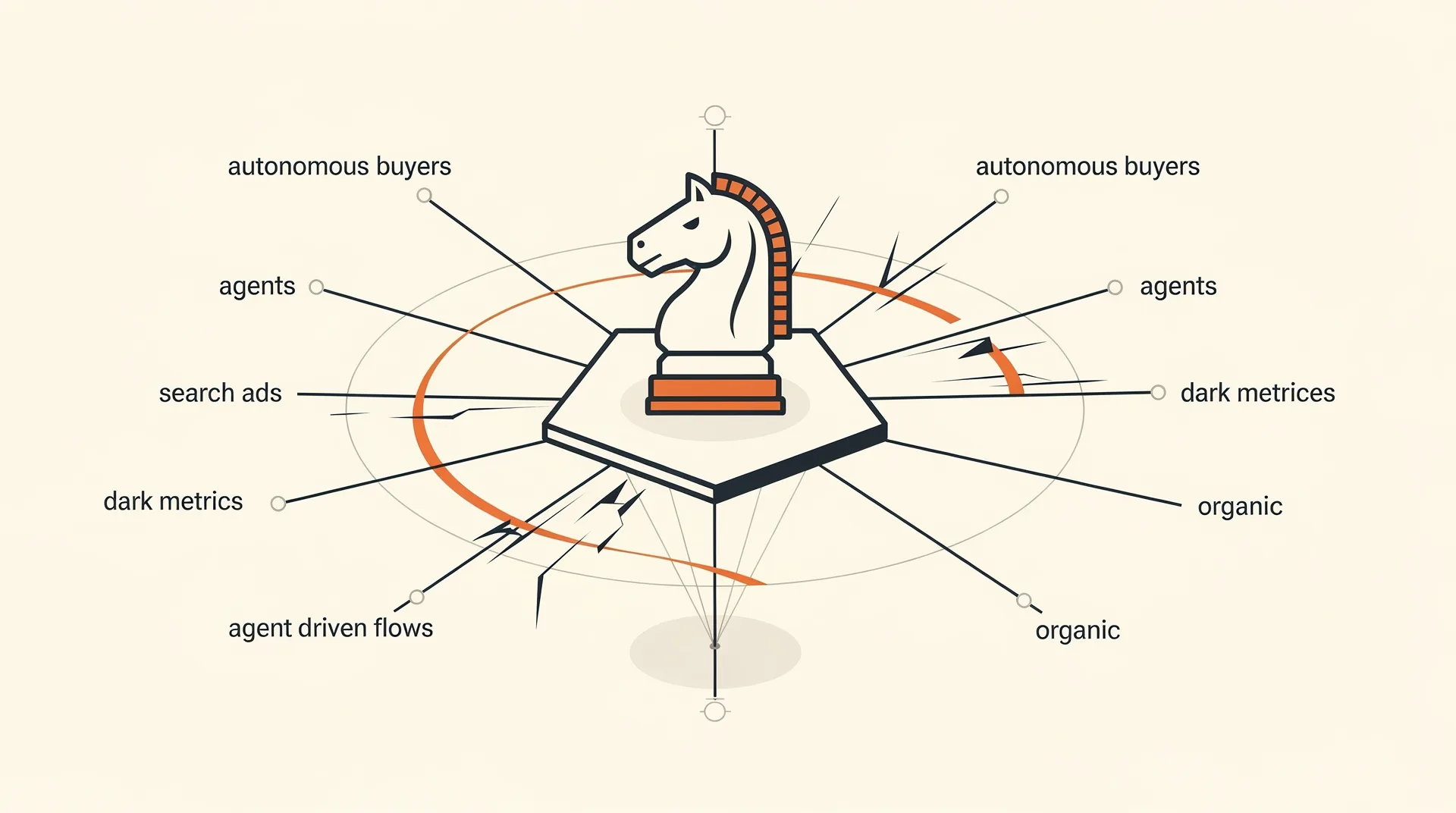
On one side, users are offloading high-intent execution tasks to autonomous software agents while migrating discovery into community platforms. On the other side, strict privacy posture and consent barriers are blinding the analytics systems meant to record what happens when users do arrive.
For growth leaders and enterprise search practitioners, navigating this terrain requires letting go of cookie-dependent session attribution and preparing infrastructure for non-human traffic.
Autonomous Agents Meet the Corporate Firewall
The customer journey is no longer exclusively human. Consumers and B2B buyers increasingly delegate multi-step web transactions—from comparing vendor specs to placing orders—to automated tools operating on their behalf.
This transition has caught digital architectures unprepared. As documented in an analysis of how enterprises treat visiting AI agents, corporate responses across major sectors have cleaved into three distinct philosophies:
* Total perimeter lockdown: Institutions like JPMorgan Chase and Charles Schwab actively block outside agents from accessing authenticated environments, prioritizing risk mitigation over programmatic convenience.
* Unmonitored credential sharing: Platforms take no proactive stance, forcing agents to log in using the human customer’s credentials, exposing the user to unmitigated liability if the agent hallucinates or executes an erroneous trade.
* Decoupled identity architecture: Retailers like Walmart are moving toward dedicated agent profiles tethered inside the human customer's primary account, granting the business visibility into both the synthetic entity and the sovereign account holder.
The architectural choice your organization makes directly dictates your reach in Generative Engine Optimization (GEO). If your technical infrastructure treats every non-standard user-agent or automated workflow as malicious scraping, you effectively lock out the automated buyers of 2025.
Treating an agent like a malicious bot will soon be indistinguishable from blocking a prospective customer at the front door.
Intent Migrates to Community Search Corridors
While autonomous agents handle the transactional execution layer, the top-of-funnel discovery layer is rapidly moving off standard search engine result pages (SERPs).
Faced with algorithmic noise, buyers gravitate toward crowd-sourced sentiment. Major platforms are aggressively commercializing this behavior. Signaling a structural shift in intent capture, Reddit has begun testing search result ads, placing contextually targeted product cards directly inside its on-platform query results alongside subreddit citations.
This move mirrors how generative search engines synthesize answers. Google’s AI Overviews and standalone engines like Perplexity rely heavily on Reddit threads to source authentic opinions, software reviews, and technical comparisons.
When platforms monetize the internal search engine of those same community hubs, the organic feedback loop tightens. Brands that rely solely on conventional on-page keyword optimization are discovering that the conversation—and the transactional intent—has already been shaped, resolved, or monetized before the searcher ever touches traditional organic search.
The Analytics Blind Spot You Can No Longer Ignore
Compounding this shift is the reality that traditional reporting tools cannot accurately measure the traffic that does arrive. Marketers evaluating performance through standard web analytics dashboards are frequently reading false negatives.
Consider what occurs when enterprise compliance tightens. In a documented case highlighting the pitfalls of modern consent enforcement, an enterprise observed a 64% drop in organic sessions after altering tag management rules to block all nonessential tracking prior to explicit opt-in. Because 57% of visitors declined or ignored consent prompts, visible conversions fell off a cliff despite actual pipeline remaining stable.
When more than half of a site’s real traffic refuses client-side tracking, conventional Google Analytics 4 (GA4) metrics cease to function as a source of truth. Relying on browser-based session counts creates dangerous strategic distortions: marketing teams conclude that organic search is dying, when in reality, the visibility layer has simply gone dark.
Between AI Overviews answering queries without clicks, synthetic agents bypassing human landing pages, and consent controls masking human visits, session-based traffic is an increasingly degraded metric.
The Playbook: What to Execute This Week
Navigating this compressed, multi-agent search environment requires an immediate recalibration of your reporting and technical posture:
1. Audit Your Bot-Management Rules for Autonomous Consumers
Meet with your engineering and security teams to review Cloudflare, Akamai, or custom WAF policies. Determine whether programmatic browsers operating with consumer-delegated tasks are being treated as hostile threats. Begin planning for authenticated agent handoffs rather than blanket IP or headless-browser blocks.
2. Disentangle Search Reporting from Client-Side GA4
Stop using browser-bound session totals as the baseline KPI for organic search health. Re-anchor your reporting on blended server-side log data, Google Search Console impressions, and first-party CRM pipeline attribution (such as self-reported attribution and demo request timestamps).
3. Establish a Native Presence in Search-Monetized Communities
Audit how your brand, software, or category appears in high-ranking Reddit and forum discussions. Combine generative engine optimization (optimizing source citations so LLMs reference your data) with targeted presence in community search inventory to intercept intent where the actual research is occurring.