What actually changed in AI marketing this year
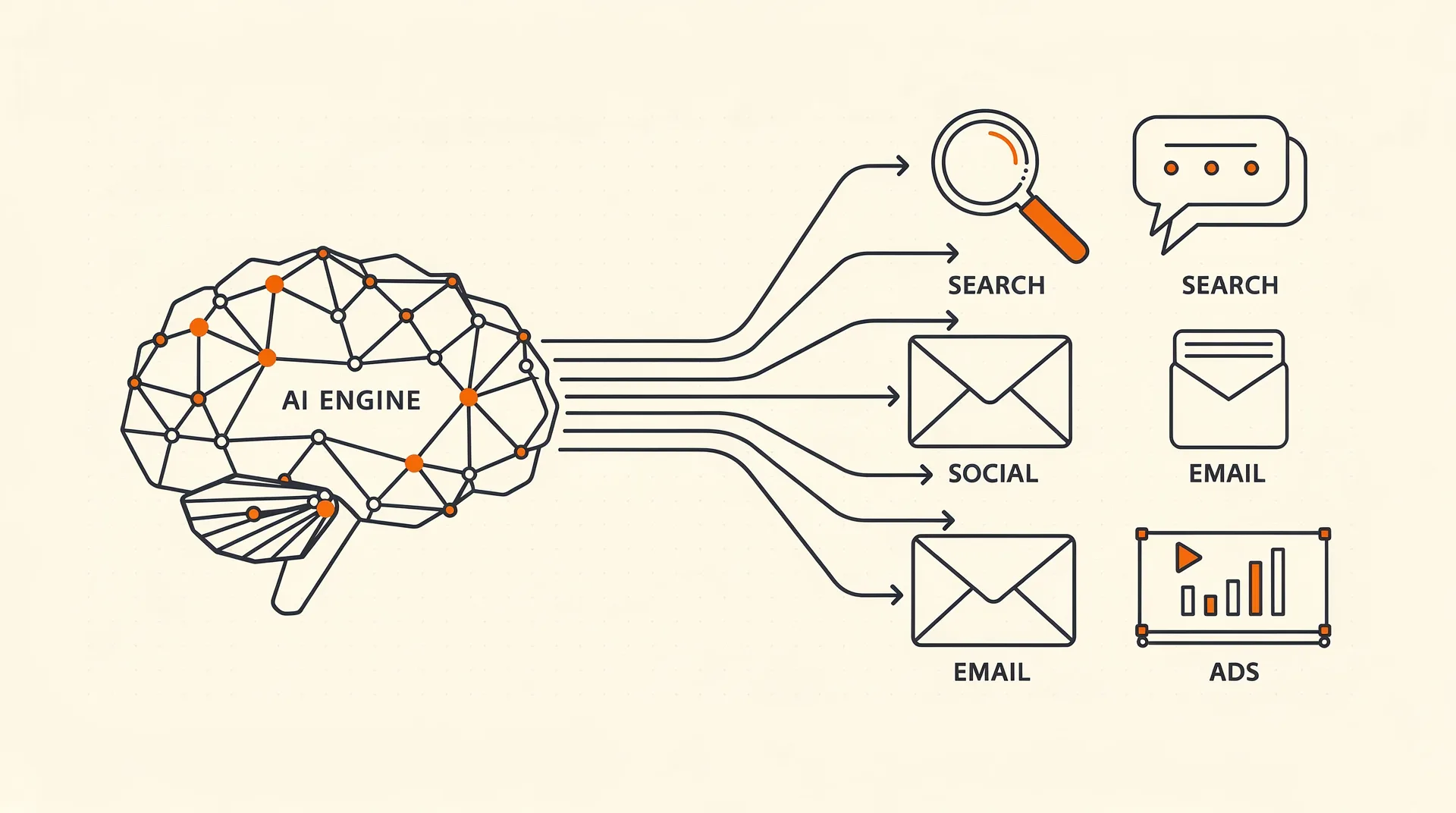
AI in marketing stopped being a “nice‑to‑have experiment” in 2024 and became infrastructure in 2025. The shift isn’t just about tools generating copy or images; it’s about how customers now find and experience brands. Around 60–70% of search queries are now processed through AI‑powered interfaces, including AI Overviews, chatbots, and enterprise copilots, which surface answers rather than raw links. This means “ranking on page one” is no longer the same as “showing up in the answer”.
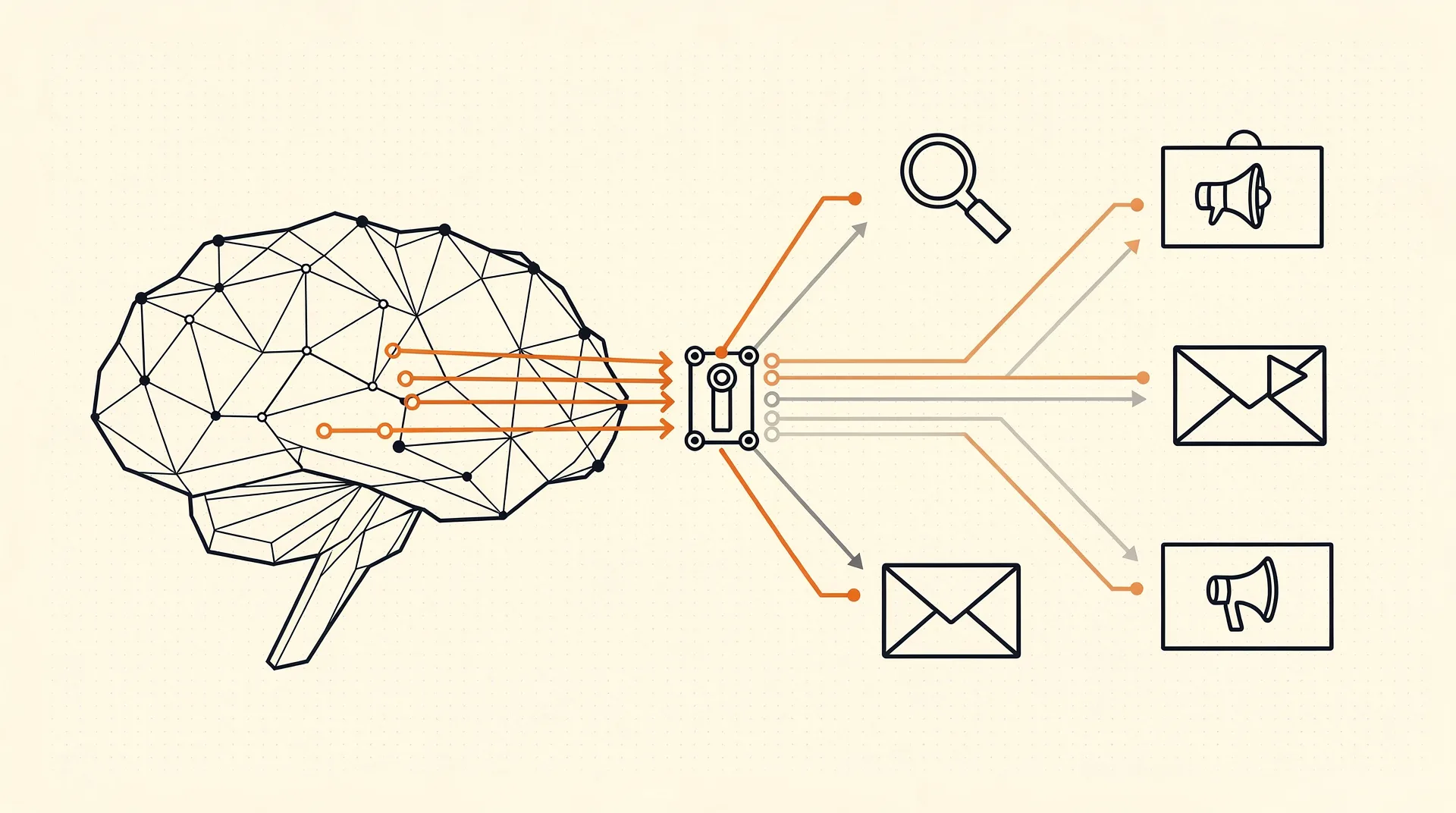
For B2B marketers, another layer has arrived: the agentic Customer Data Platform. Traditional CDPs unified profiles; the new “agentic CDP” layer treats data as a source of decisions, not just segments. Platforms like Hightouch and Databricks’ CustomerLake already talk about customer decisions as the unit of orchestration, not lists of people. That changes how marketers think about automation: it’s less “send this email to segment X” and more “activate this decision loop when behavior Y happens.”
None of this removes the need for human judgment. But it does change the threshold. AI isn’t a peripheral skill anymore; it’s the baseline for how marketing workflows are built, measured, and scaled.
Why this matters for marketers (especially B2B)
For B2B marketers, the stakes are higher because deals are more complex, buying committees are larger, and trust is non‑negotiable. AI‑driven tools can surface answers; they can’t replace the earned trust that comes from consistent, accurate, and contextually relevant messaging. Yet entirely ignoring AI means ceding your brand narrative to the models that now mediate how prospects research, compare, and short‑list vendors.
There are three concrete implications:
- Positioning is now indexed by LLMs. Large language models compare features, highlight USPs, and cite external sources. If your content isn’t structured so that key differentiators are clearly surfaced, competitors will be the brands that AI recommends.
- Measurement is deeper and more opaque. AI‑powered dashboards and predictive models can surface “what happened” and “what might happen,” but they require clean data, clear attribution, and close oversight. Ignoring data quality while rushing into AI‑driven insights produces flawed decisions, not speed.
- Workflows are being redesigned around AI‑assisted decisions. From audience segmentation to creative variants, from content refresh to lead nurturing, AI‑assisted workflows are becoming the default. Marketers who keep operating as if AI is optional will inherit unmaintainable, slower, and less measurable processes.
The one move to make this week: pilot an AI workflow around a high‑friction task
Most companies start AI the wrong way: by picking a shiny tool, then trying to “find use cases.” The faster payoff is to start with a workflow that already hurts, already has a baseline, and already ties to a clear metric. The practical move this week is:
Pick one high‑friction task, define a baseline, insert AI where it removes friction, and measure the impact after one cycle.
Here’s how to run it:
- Choose the task. Common candidates are campaign reporting, audience segmentation, content refresh, or lead‑nurture drafting. These are repetitive, time‑consuming, and already measurable.
- Define the baseline metric. Examples: turnaround time (hours or days), conversion rate, cost per lead, or output quality scored by a rubric. This creates the before/after fence.
- Insert AI only where it removes friction. Use AI to generate first drafts, summarize data, or populate audience hypotheses, but keep human judgment in the loop for brand, accuracy, and strategy. Avoid “set it and forget it” automation, especially with customer‑facing outputs.
- Measure the impact. After one cycle, compare before/after metrics. If the win is clear on time, cost, or quality, scale; if not, stop or refine and try again.
This move is cheap to test, fast to run, and aligns with IBM’s and BCG’s guidance to start with a narrow use case, build data foundations, and then scale AI‑led workflows across the stack.
How to structure your AI‑ready content and assets
Even if your campaigns aren’t fully AI‑driven yet, your content is being read and indexed by LLMs. The way to future‑proof your brand is to think in terms of “marketing to machines” as much as to humans. The new playbook includes:
- Aligning with natural language queries. Users increasingly ask full‑sentence questions rather than typing single keywords. Your content should answer these questions directly, in clear, concise paragraphs that can be extracted and cited.
- Using formats LLMs can parse. Bullet‑point lists, short paragraphs, and structured product tables help AI read and reuse your information. Headers that map to common questions (e.g., “How does X compare to Y?”) make your brand more likely to be surfaced.
- Reinforcing a consistent USP. If your brand is positioned on affordability, high‑luxury visuals will confuse models and people alike. Every asset—copy, design, and data—should push the same narrative so AI doesn’t create internal contradictions.
You don’t have to rewrite everything at once. A practical weekly habit is to pick one existing page or asset, feed it through a few LLMs with prompts like “Which brand is best for X?” and observe how your content is summarized. Use that insight to tighten positioning, clarify differentiators, and prune ambiguous language.
Getting started without over‑engineering
The biggest mistake companies make is trying to “AI‑ify” everything at once. The smarter path is to start small, build a muscle, and then expand. A few concrete steps:
- Identify two to three AI goals for the next quarter. Examples: “Establish reliable data foundations for AI insights,” “Pilot three AI‑assisted workflows,” or “Audit how AI surfaces our brand in key search topics”.
- Create a cross‑functional AI task force. Marketing, engineering, IT, legal, and agency partners should be in the same room. AI‑driven workflows often touch infrastructure, compliance, and security, so alignment can’t be an afterthought.
- Train on AI, not just with AI. Take one home project or internal workflow and treat it as a sandbox: build a dashboard, analyze a dataset, or optimize a simple process using AI tools. This creates practical skills that transfer directly to work, without the risk of production mistakes.
AI marketing in 2026 isn’t about replacing marketers. It’s about marketers who use AI to amplify their judgment, scale their creativity, and sharpen their measurements—while competitors who delay will find their brand tucked away in the footnotes of AI‑generated answers.