What changed
AI marketing is moving away from volume-first automation and toward signal-first decisioning. The clearest proof is the shift from routing contacts on isolated actions to orchestrating behavioral, firmographic, and intent signals to determine account readiness.
That matters because the old model often treats a single click or form fill as the trigger for sales follow-up. Signal orchestration instead tries to answer a better question: which accounts are actually in market, which stakeholders are engaged, and what should happen next?
At the same time, broader AI marketing guidance is converging on the same theme. Marketers are being pushed to break down channel silos, use first-party data more intelligently, and connect media, content, and measurement into a shared workflow rather than separate motions.
Why it matters for marketers
The business issue is not usually lead volume. It is signal quality. If marketing is optimizing for raw contact capture, sales gets noisier handoffs and important buying committees can be missed entirely.
That is a real strategic shift for B2B teams. AI is increasingly being used to identify and segment audiences, compare past targeting performance, and surface new buyers more likely to convert, which only works when the input data is rich enough to distinguish readiness from noise. In practice, that means the value of AI marketing is less about producing more content or more automation, and more about improving the judgment layer above the workflow.
Consumer expectations are also rising in parallel. Research summarized by MarTech says people are more comfortable using AI when it is fast, transparent, and clearly identified as AI, which raises the bar for brand experience across every touchpoint. For marketers, that is a warning: if the automation layer is clumsy, customers now notice faster and tolerate less.
The new operating model
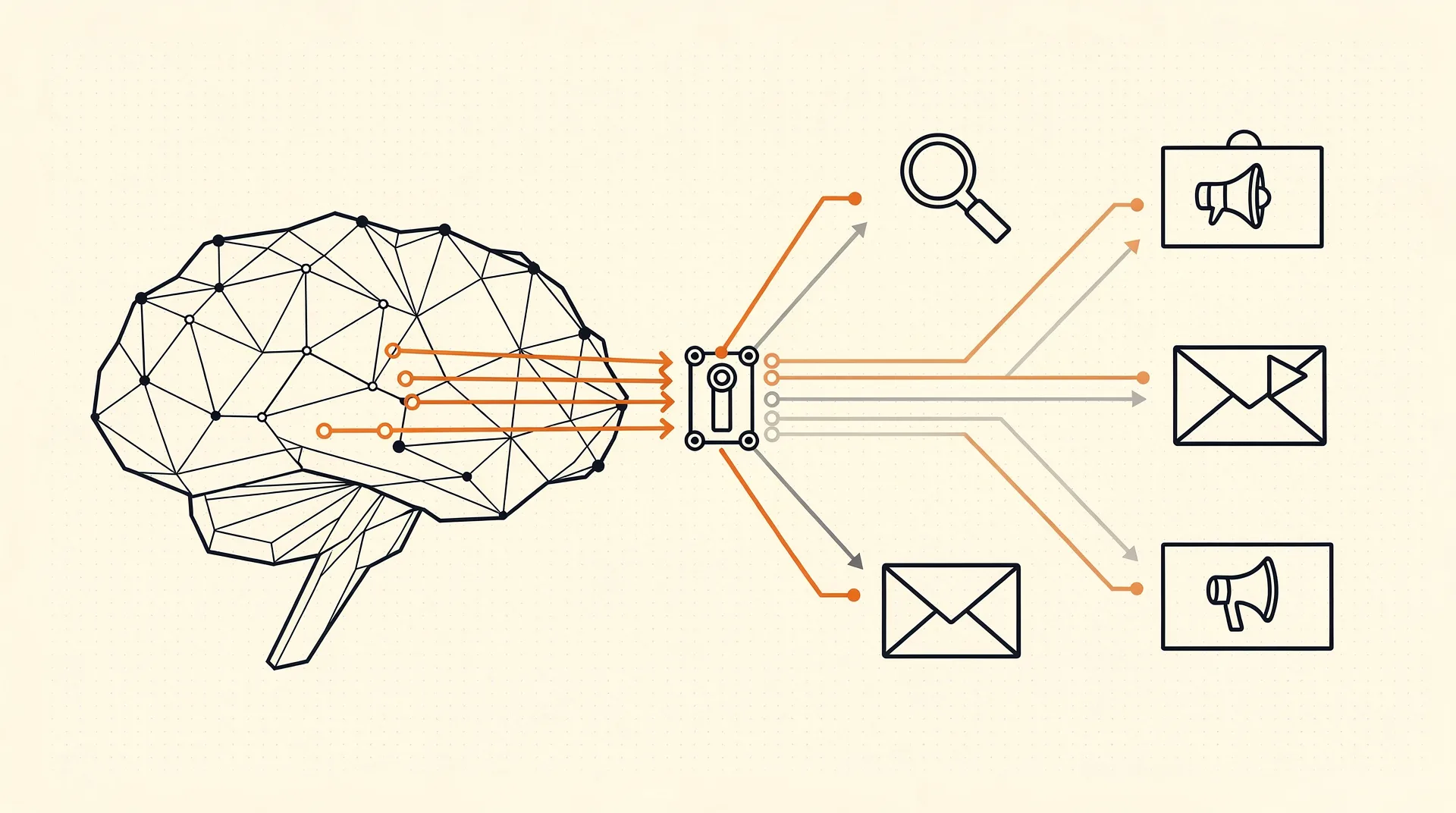
The emerging model has three parts:
- Gather signals from behavior, firmographics, and intent rather than relying on one-off actions.
- Interpret signals with predictive scoring or AI-assisted segmentation to identify which accounts are actually warming up.
- Act on signals with coordinated sales and marketing responses, not isolated nurture or blanket routing.
This is where the strongest AI marketing programs are headed. BCG frames the first stage of AI maturity as building the foundation: AI-ready data management, first-party data activation, and modular creative systems that can be adapted across channels. IBM makes a similar point, arguing that AI should help marketers identify likely buyers, establish a baseline, and build intelligent workflows around it.
The practical implication is simple: AI is most useful when it tightens the connection between data, creative, and action. It is least useful when it is layered on top of a fragmented process.
What good looks like now
A credible AI marketing program now looks less like “we use AI everywhere” and more like “we use AI where it improves decision quality.”
That includes:
- Using first-party and intent data to sharpen audience definitions.
- Designing content and assets that AI systems can parse, summarize, and reuse, including clear structure, concise paragraphs, and extractable information.
- Creating cross-functional workflows so media, SEO, content, and sales operate from the same signals and terminology.
- Reviewing generated output with human expertise, especially where brand voice, accuracy, or buyer trust is at stake.
This is consistent across the sources. Wired’s sponsored guide emphasizes testing how LLMs actually describe a brand, then tailoring content so models can extract and reuse the right information. Content Marketing Institute and Orbit Media both point toward the same editorial discipline: audit language, plan distribution early, and use AI to support research and iteration rather than replacing strategy.
The practical move to make this week
Start with one narrow signal-orchestration audit.
- List the top 5 signals your team currently uses to decide whether an account is “ready.”
- Mark which of those signals are behavioral, firmographic, intent-based, or just proxy metrics.
- Compare those signals against closed-won accounts from the last quarter and identify which signals actually correlated with conversion.
- Remove at least one weak routing rule that overweights low-confidence activity, such as a single page visit or shallow engagement.
- Replace it with one stronger readiness rule that combines multiple signals before sales is alerted.
If you want a faster editorial version of this same move, audit one campaign or content cluster to see whether it is optimized for search, AI extraction, and buyer readiness at the same time. That means checking whether the page answers natural-language questions, surfaces brand expertise clearly, and gives AI systems something structured to quote or summarize.
The strategic takeaway
The next AI marketing advantage is not more automation. It is better orchestration.
Teams that win will be the ones that connect fragmented signals into one readiness model, then use that model to route attention, content, and sales effort more intelligently. In other words: stop asking how many leads AI can generate, and start asking which accounts AI can help you recognize sooner.
What to watch next
Expect more pressure on marketers to prove that AI improves both speed and precision. The sources point to three durable priorities: stronger first-party data foundations, tighter cross-channel workflows, and content that is built for both humans and AI systems to understand.
The teams that move first will not necessarily publish the most AI content. They will be the ones that turn signal quality into a measurable operating advantage.