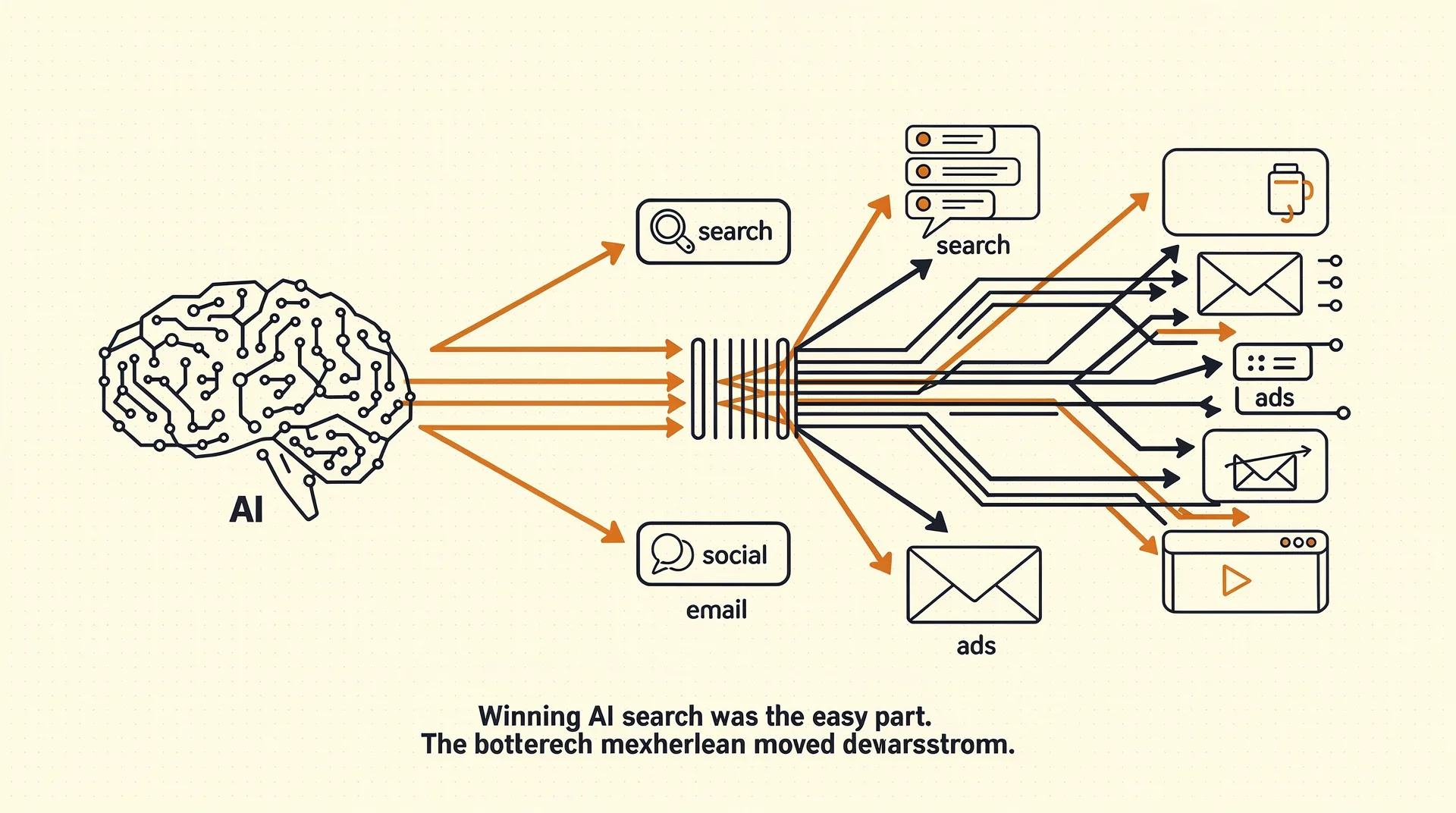
For two years the AI marketing conversation had one centre of gravity: getting cited by the answer engine. That conversation is now settling into place as a baseline requirement rather than a differentiator — and three quieter shifts are determining who actually converts the traffic that AI search sends them.
What changed
The first shift is that AI visibility stopped being the finish line. Winning the citation gets you into the consideration set; it does not get you through it. MarTech's analysis of B2B buyer behaviour is blunt about the failure mode: confusing navigation, vague claims, and missing evidence cost you buyers, regardless of how well you rank or how often you're quoted in a generative answer.
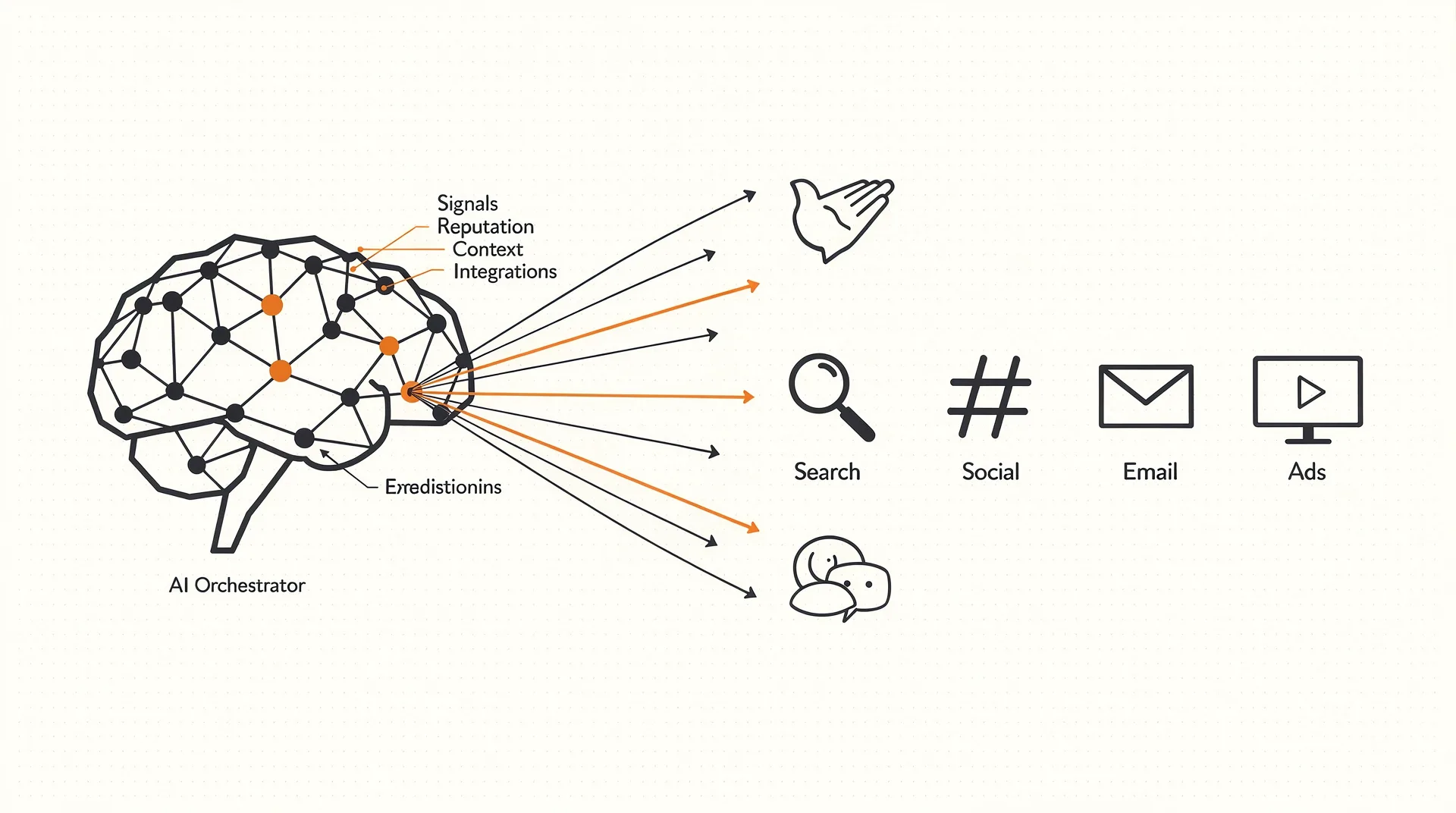
The second shift is structural. Marketing operations teams are shifting from task executors to AI fleet managers, running autonomous agents alongside the traditional software stack rather than operating that stack by hand.
The third is competitive. Some of Marketo's original architects bet AI can replace the complex workflows and manual configuration that marketing ops has built careers around.
Read together, these are not three separate trend pieces. They describe one migration: value is moving out of the top of the funnel and out of the configuration layer, and into the two places AI cannot yet reach — the buyer's decision moment, and the operational judgement that decides which agents get to act.
Why AI visibility alone doesn't move B2B buyers
Generative engines compress the research phase. A buyer arrives pre-briefed, having already absorbed a synthesised answer that names you alongside two competitors. That sounds like progress. It is actually a compression of the window in which you can differentiate.
Cognitive-load testing is the diagnostic discipline that catches this, because it measures the effort a buyer expends to understand and verify what you claim — not whether they liked the page. When the answer engine has already told them what you do, the landing page's job changes. It must resolve doubt, not introduce capability. Navigation that made sense when you controlled the narrative becomes friction when the buyer arrives mid-decision with a specific unresolved question.
The practical consequence: your AI-search performance metrics and your conversion metrics are now measuring two different funnels, and the gap between them is a usability problem, not a traffic problem.
Your MarTech stack is becoming a workforce
The operational shift is less about tools than about org design. If agents execute tasks, the MOps role stops being "build the campaign" and becomes "define the boundary conditions under which an agent may act." That is a governance job, and most teams have not hired or trained for it.
The uncomfortable part is that agent fleets remove the audit trail that manual configuration gave you for free. A human building a workflow leaves evidence of intent at every branch. An agent optimising toward a goal leaves evidence only of outcome. Teams that move fastest here will be the ones that instrumented decision logging before they scaled autonomy — not after.
The workflow builder is the thing being automated
Marketo's complexity was never the point; it was the tax paid for expressiveness. The challenger thesis is that AI collapses that tax — that intent can be expressed in plain language and the configuration generated. If that holds, the durable skills in marketing ops shift from platform fluency to systems specification: knowing precisely what should happen, to whom, under what conditions, and what must never happen.
That is a harder skill to hire for than Marketo certification, and a much harder one to outsource.
The practical move this week
Pick one high-intent landing page — ideally one that AI search already cites — and run a cognitive-load pass on it. Ask three people unfamiliar with your product to complete one task while narrating where they hesitate. Log every point where they have to re-read a claim or hunt for evidence. Fix the top two. The evidence gap is usually a missing proof point sitting three scrolls below the claim that needed it.
Then, in the same week, write down one agent policy: which decisions an autonomous system may take unsupervised, which require a human gate, and what gets logged either way. One page is enough. The teams restructuring for agent-driven operations are discovering that this document is the actual migration plan — the tooling follows from it.
The honest counterpoint
None of this is settled. Agentic automation replacing mature platforms is a claim from people with a commercial interest in it being true, and enterprise marketing stacks are notoriously sticky for reasons of compliance and integration debt rather than affection. Treat the automation challenger narrative as a directional signal, not a forecast.
What is not speculative: buyers now arrive with less patience and more prior context than at any point in the last decade. Whatever runs your stack, that is the constraint you are optimising against.