The AI conversation in marketing has split into two useless camps: the one promising that generative tools will double your pipeline by Q4, and the one quietly unfollowing anyone who mentions "prompt engineering." Both camps miss the actual story. Three recent pieces of thinking — on ROI measurement, on the future of the CMO role, and on what technology history teaches us about jobs — add up to something sharper: AI isn't a tool you buy, it's an operating model you build, staff, and defend.
The ROI question was being answered wrong
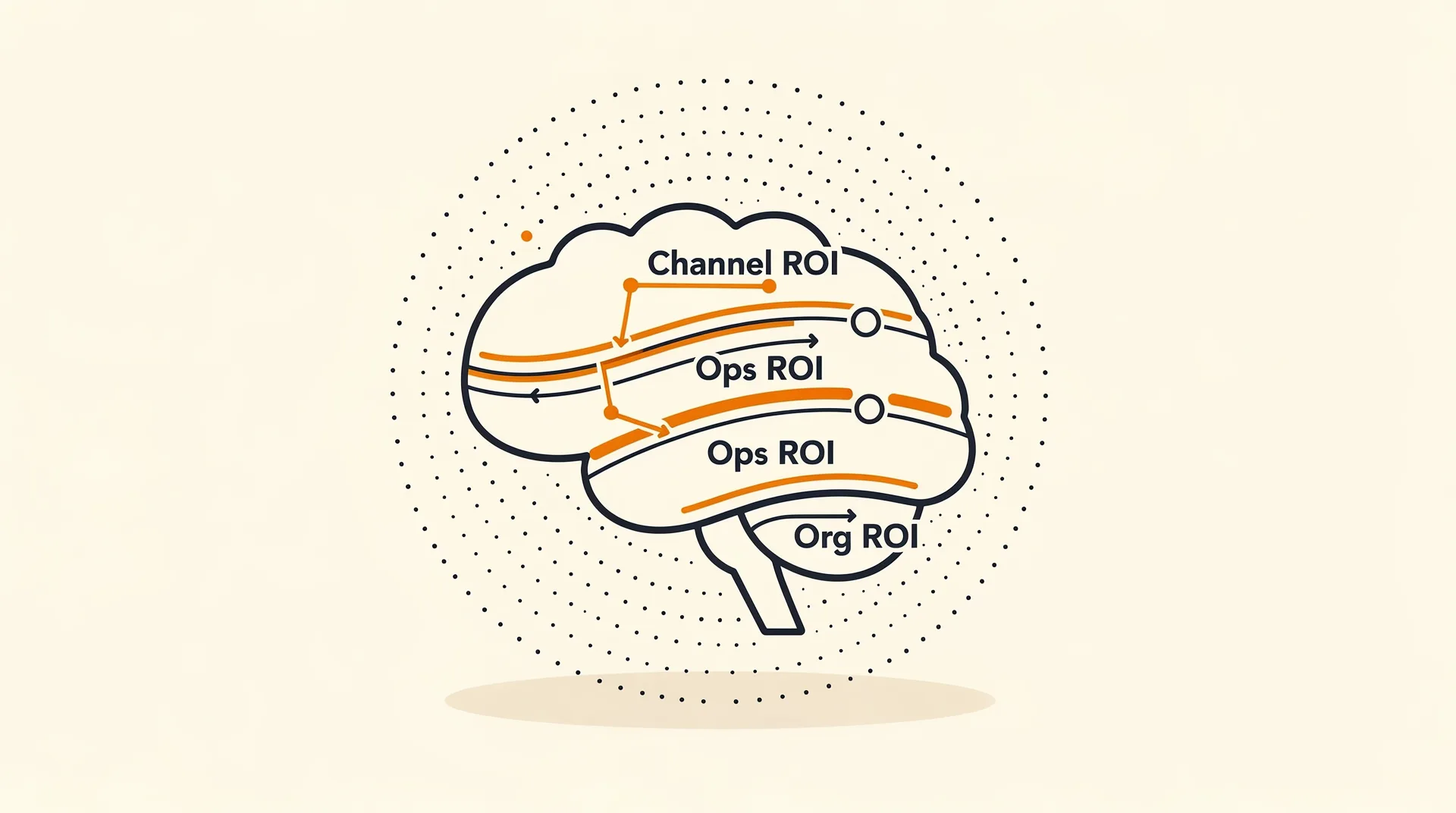
The most useful thing published on AI measurement recently argues that the problem isn't a lack of dashboards — it's that marketers keep trying to draw a straight line from an AI deployment to revenue, when most AI value doesn't travel that path. A better way to answer the AI ROI question proposes a three-layer framework: foundations, working systems, and business outcomes. The discipline is in what each layer is allowed to claim. Foundations — data hygiene, governance, the plumbing nobody demos — earn investment on enablement, not revenue. Working systems — the copilots, the automated workflows, the AI-assisted content engine — earn credit on cycle time, cost, and throughput. Only outcomes get to talk about pipeline and revenue, and only when attribution can actually support the claim.
Why does this matter right now? Because boards are asking "what's our AI ROI?" and the honest answer for most organizations is "we haven't built the layers that make that question answerable." Claiming revenue before you can prove it doesn't just fail the CFO's sniff test — it poisons the well for every future AI investment request.
The CMO role is quietly changing job descriptions
The second piece is about who's best positioned to run marketing when AI is the operating model. Your next CMO will come from marketing operations tracks a real shift: the role moving from primarily creative steward toward something more technical and systems-oriented — and, notably, finding an ally in the CIO. That alliance matters because the three-layer ROI framework above is unbuildable without infrastructure, data governance, and security postures that marketing has historically borrowed from IT on a handshake.
If you're a marketing leader, the practical read is this: your successor will be judged on their ability to run marketing as a system — measurement architecture, data flows, AI governance — not just on brand instinct. If you're building a marketing team today, ops talent is no longer a support function. It's the succession plan.
History's honest take on AI and jobs
The doom-and-utopia binary about AI and employment gets a useful corrective from an unlikely place: desktop publishing. What WYSIWYG editors can teach us about AI and jobs makes the case — tracing from WYSIWYG editors to today's vibe coding — that technology tends to shift where human skills matter rather than simply eliminating them. Typesetters didn't vanish because typography vanished; the skill moved, and the people who moved with it did fine.
The honest caveat, which the piece doesn't dodge: "shifted" is not "no one was hurt." Some roles did disappear. But the pattern for marketers is clear enough — the durable skill isn't operating any specific tool, it's judgment about what good output looks like and the taste to insist on it.
What connects all three
Read together, these pieces describe a single arc: AI is maturing from novelty to infrastructure, and the organizations winning at it are the ones that treat it structurally — measured in layers, led from ops, staffed by people whose skills survived the last platform shift. None of that is sexy. All of it is defensible in a budget review.
The move to make this week
Pick one AI initiative you're running and map it against the three layers. If you can't say which layer its claims belong to, you're not measuring it — you're narrating it. Write down the foundation it depends on, the system metric it should move (cycle time, cost per asset, throughput), and whether a revenue claim is actually provable. Then bring that one-pager to your next leadership conversation. It's the difference between asking for AI budget and asking for infrastructure investment — and only one of those survives contact with a CFO.
The marketers who thrive through this shift won't be the ones with the best prompts. They'll be the ones who can explain, in a framework a board understands, exactly what the AI is doing, what it costs, and what it's allowed to claim. That's not a tooling skill. That's an operating model — and it's hireable, buildable, and available this quarter.