What Changed This Week
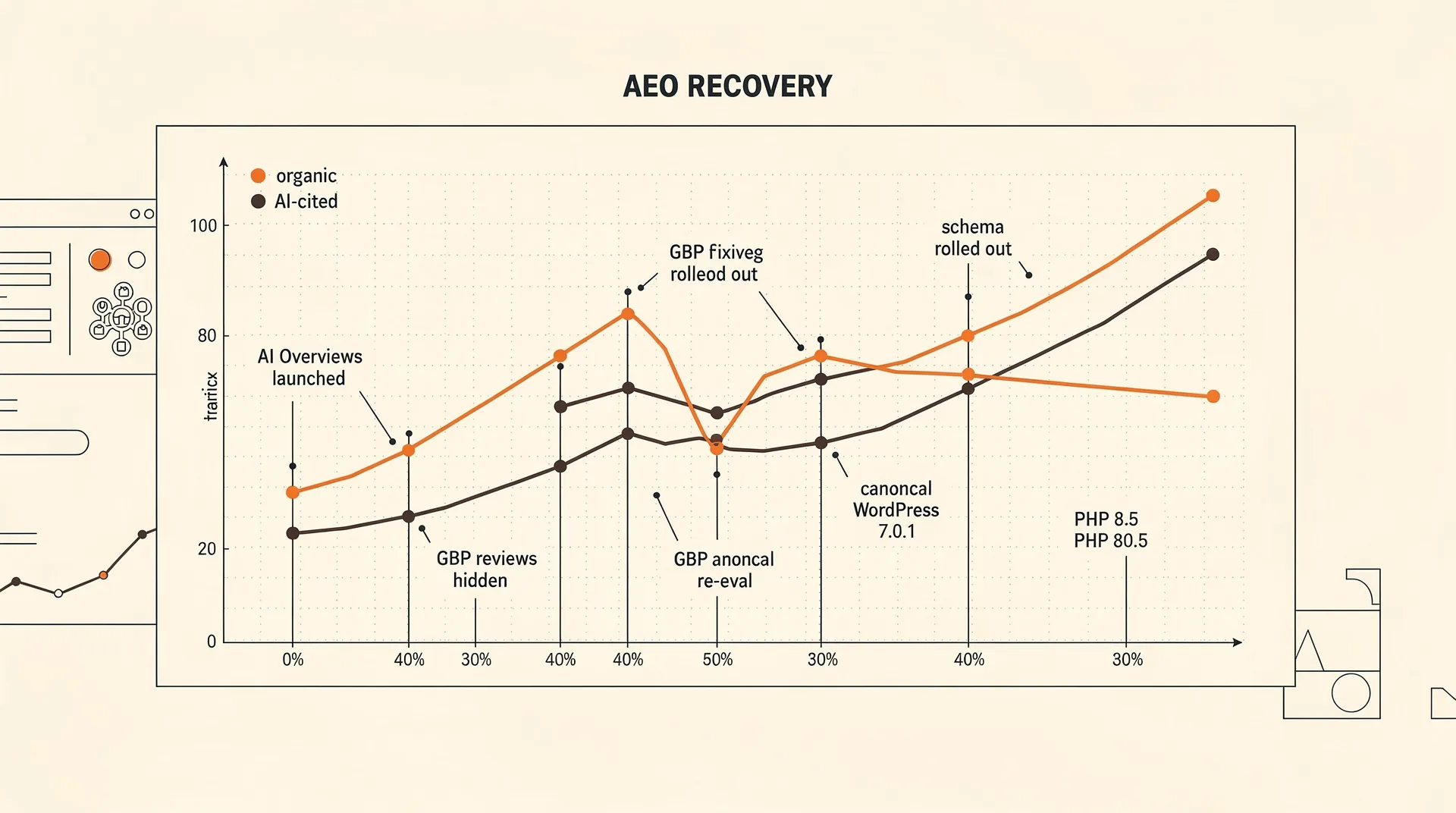
Three critical shifts are disrupting AI SEO and generative engine optimization (GEO) traction: Google Business Profile dashboards are showing empty review panels while public listings still display review counts, Google now explicitly states canonical re-evaluation can take up to two weeks after content fixes, and WordPress 7.0.1 patched 31 bugs including PHP 8.5 compatibility and a security-related function. These aren’t minor glitches; they’re signal fractures that AI overviews and search engines rely on to assess trust, authority, and relevance.
The review dashboard issue is a display bug, not a removal. Public review counts remain visible, but the reply panel shows “You have no reviews yet” Google Business Profiles Showing Empty Review Dashboards. This matters because AI systems increasingly use review volume and sentiment as trust signals. If your dashboard can’t surface reviews, you can’t respond, moderate, or leverage them for content—directly weakening your AI-visible authority.
Meanwhile, Google’s updated canonicalization guide introduces a two-week waiting window for clustered pages to split after content differentiation Google Says Canonical Re-Evaluation Can Take Up to Two Weeks. For AI SEO, this means duplicate content fixes won’t instantly improve ranking signals fed to generative engines. The delay compounds if you’re relying on `Request Indexing` to accelerate re-evaluation, which Google advises using only for high-priority URLs.
WordPress 7.0.1 doesn’t add SEO features, but its PHP 8.5 compatibility fix ensures your CMS won’t break as servers upgrade, and the `wp_kses()` security patch prevents malicious code injection that could corrupt content integrity WordPress 7.0.1 Maintenance Release. Broken CMS functions = broken content signals = degraded AI performance.
Why This Matters for Marketers
AI overviews and GEO engines prioritize verified, non-duplicate, trustworthy content. When review dashboards hide replies, you lose the ability to engage with customer sentiment—a key trust signal. When canonical clusters linger for two weeks, duplicate content continues to dilute ranking signals, confusing AI models about which page to surface. And when CMS security functions fail, your site’s integrity crumbles, triggering trust penalties across search and AI systems.
The review dashboard bug is particularly dangerous because it’s silent: your public listing shows 916 reviews, but your dashboard says zero Google Business Profiles Showing Empty Review Dashboards. You can’t respond to reviews, track sentiment, or use them in content—yet AI systems may still see the public count. This creates a mismatch between your operational reality and AI trust signals.
For canonical clusters, the two-week window means content fixes won’t yield immediate ROI. If you’re optimizing for AI overviews, you need clean, unique content quickly. Delayed re-evaluation slows your ability to capture generative traffic.
WordPress’s security patch is critical for long-term signal integrity. Malicious code injection can alter content, inject spam, or break structured data—directly harming AI SEO.
The Practical Move This Week
Do this immediately:
| Action | Why | Method |
|--------|-----|--------|
| Verify review visibility | Confirm if reviews are missing or just hidden from dashboard | Check live listing via incognito; if reviews appear, it’s a dashboard bug Google Business Profiles Showing Empty Review Dashboards |
| Contact GBP support | Force manual review if dashboard shows zero | Use “Contact support” with business ID, previous vs. current count, and screenshot Missing Google Reviews? Here's How to Get Help! |
| Request indexing on critical URLs only | Accelerate canonical split for high-priority pages | Use `Request Indexing` in Google Search Console for top 5–10 URLs; avoid spamming for entire clusters Google Says Canonical Re-Evaluation Can Take Up to Two Weeks |
| Audit duplicate clusters | Identify pages with unclear content differentiation | Use Search Console’s “Duplicate, Google chose different canonical than user” report; ensure content differences are distinct Google Says Canonical Re-Evaluation Can Take Up to Two Weeks |
| Update WordPress to 7.0.1 | Patch PHP 8.5 and security function | Install minor update via dashboard; no new APIs or performance gains, but critical fixes WordPress 7.0.1 Maintenance Release |
Priority order: Start with GBP review verification, then canonical audit, then WordPress update. Review signals are highest-impact for AI trust; canonicals affect ranking velocity; CMS security protects long-term integrity.
How AI Systems Interpret These Signals
AI overviews and GEO engines use review volume, sentiment, and engagement as trust proxies. When your dashboard hides reviews, you lose the ability to respond—reducing engagement signals that AI models use to assess business reliability. Public counts may persist, but AI systems increasingly cross-reference operational data (e.g., response time, sentiment trends) with public metrics.
For canonical clusters, AI models prioritize unique, authoritative content. When duplicate pages linger for two weeks, AI systems may surface outdated or less relevant content, diluting your generative traffic. The delay in re-evaluation means your optimization efforts won’t translate to AI visibility immediately.
WordPress’s security patch ensures content integrity. Malicious code can alter structured data, inject spam, or break content—directly harming AI trust signals. Clean, secure content is foundational for AI SEO.
What to Monitor Next Week
- GBP dashboard restoration: Track if the display bug resolves or persists. If reviews remain hidden, continue support tickets.
- Canonical cluster split rate: Monitor if distinct content differences accelerate cluster resolution within the two-week window.
- WordPress update impact: Verify no CSS/JS breaks post-update; ensure PHP 8.5 compatibility functions as expected.
Final Take
AI SEO is not just about content creation; it’s about fixing broken signals. Review dashboards, canonical clusters, and CMS hygiene are the foundation of AI trust. This week, prioritize verification, audit, and update—then wait for signals to propagate. AI overviews reward consistency, not speed. Fix the signals, and the traction will follow.